
The short answer
Otterly.AI, Scrunch AI, and Goodie AI solve three different problems that all look like the same problem from the outside. Otterly is the cheapest honest way to find out whether AI engines mention you, starting at $29/month. Scrunch is built for teams that will model customer journeys and study how AI agents move through their site, starting at $250/month billed annually. Goodie is built for teams that will act on what they find and connect it to revenue, starting at $399/month billed annually. Pick by what your team will actually do with the data, because all three will happily sell you a dashboard nobody opens.
How I did my comparison
I priced all three off their own pricing pages in July 2026. Not off review sites, which turned out to matter more than I expected.
I run Goodie, so I know that product from the inside. I haven't run Otterly or Scrunch on my own prompt sets. What follows on those two is what they publish, what they commit to, and what their pricing structure tells you about the buyer they built for. Where I have an opinion, it's about fit, not feel.
Scoreboard, surface, or loop
Feature-count comparisons mislead buyers in this category because the three tools aren't competing on the same axis. They sit at three levels of an AEO program. A scoreboard tells you where you stand. A surface shapes how AI agents experience you. A loop closes the gap between the two and proves it paid.
Goodie is a loop. It answers the expensive question: what do we fix, and did it make money? Research, monitor, act, attribute, then run it again.
Otterly is a scoreboard. It answers the first question: are we showing up? Daily tracking, four engines, a visibility index, a GEO audit. Cheap and fast to stand up.
Scrunch is a surface. It answers a different one: how do AI agents experience us? Personas, agent traffic monitoring, page audits, and AXP, which generates an AI-readable version of your site.
Scoreboard, surface, loop. The most common mistake I see is buying the loop before there's anyone to run it.
If you want the metrics counterpart to this, I laid out the Measurement Ladder (Presence → Citation → Revenue) in a separate piece on measuring AI search visibility. Tooling and metrics move up in the same order.
What an AEO platform actually does
An AEO platform runs prompts against answer engines on a schedule, records whether your brand appears, in what position, with what sentiment, and which sources the engine cited to build its answer. That's the floor. Everything above it varies by vendor: some add recommendations, some add content generation, some add attribution back to sessions and pipeline, some monitor which AI crawlers hit your site and what they took.
The reason this exists as a product category at all is that your SEO stack can't see any of it. Rank tracking tells you where you sit on a results page. It tells you nothing about whether ChatGPT recommends you when someone asks what to buy.
The pricing everyone is quoting is out of date
I pulled the current top-ranking reviews for both tools, then pulled the vendor pricing pages the same day. On Scrunch, the two didn't match.
A currently-ranking Scrunch review states the entry plan is $250/month for 125 prompts across four engines, with Claude, Gemini, Meta and AI Mode reserved for Enterprise, and no free trial available.
Scrunch's own pricing page, as of July 2026, states: Starter is $250/month billed annually or $300 month-to-month, with 350 custom prompts plus 1,000 industry prompts, coverage listed across ChatGPT, Claude, Gemini, Perplexity, Google AI Mode and AI Overviews, and Meta, and a 7-day free trial.
That's a 2.8× difference in prompt allowance, a materially different engine list, and a trial that a buyer reading the review would think doesn't exist. Somebody using that review to build a shortlist would rule Scrunch out for reasons that stopped being true.
I'm not naming the site, because the practice matters more than any one publisher. The AEO review economy is roughly eighteen months old and largely built on scrapes that nobody re-runs. Vendors in this category ship pricing changes monthly. The reviews don't.
So price everything off the vendor's own page, on the day you're budgeting. Including this article, which is a snapshot dated July 2026 and will decay like everything else.
The prompt is not the unit
All three vendors sell "prompts," and all three mean something different. Otterly sells 15, 100, or 400 search prompts. Scrunch sells 350 custom prompts plus 1,000 industry prompts, which are separate pools. Goodie sells 100 prompts and publishes 3,000 analyzed responses, roughly 30 responses per prompt per month.
That response count is the actual unit of data you're buying, because one prompt run daily across four engines produces far more than one prompt run weekly across two. Of the three, only one publishes the denominator.
I'm aware how that reads coming from me. Check it yourself on all three pricing pages, and if Otterly or Scrunch publish a response count I couldn't find, I'll correct this.
Side by side
| Goodie AI | Otterly.AI | Scrunch AI | |
|---|---|---|---|
| Entry price | $399/mo annual | $29/mo ($25 annual) | $250/mo |
| Prompts at entry | 100 | 15 | 125 |
| Responses published | 3,000/mo | Not published | Not published |
| Engines at entry | 5 | 4 | 4 |
| Engines at top tier | 12 | 7 (3 as add-ons) | 9 |
| Add-on model | Tier upgrade | Per engine, per tier ($9–$439) | Tier upgrade |
| Seats | 3 / 5 / unlimited | Unlimited, all tiers | 5 / custom |
| Free trial | 7 days | Yes | 7 days |
| Action layer | All tiers, ships fixes | Recommendations | Site audits |
| Attribution | GA revenue attribution | Agent Analytics (Standard+) | Not listed on pricing page |
| API / MCP | MCP all tiers | Standard and above | API at Enterprise |
| Best for | Acting on it and proving revenue | Validating whether you appear | Benchmarking before you scale |
Goodie AI: the closed loop
Three brand tiers plus a separate agency track, published on Goodie's pricing page:

- Core, $399/month billed annually, self-serve: ChatGPT, AI Overviews, AI Mode, Perplexity, Copilot. 100 prompts and 3,000 analyzed AI responses per month. 10 optimization actions. Revenue attribution through Google Analytics. MCP server access. An AEO strategy call. 3 seats and email support. 7-day free trial
- Pro, $999/month billed annually: adds Gemini plus the retail assistants, Amazon’s Alexa for Shopping and Walmart’s Sparky. 250 prompts, 7,500 responses, 30 actions, prompt and demand research, SKU-level agentic commerce visibility, 5 seats and priority support
- Enterprise, quote-based: up to 12 models including Claude, Meta AI, DeepSeek and Grok. 500+ prompts across single and multi-brand, 60+ actions, custom revenue modeling and attribution, full API and export, dedicated strategist, unlimited seats
- Agencies price separately: Growth at $350/month billed annually, or $420 billed quarterly. 10 pitch workspaces a month, full client workspaces with each client on their own brand plan, unlimited seats. Agency Enterprise is custom
What the four layers do
Research. Prompt and demand research, so you're not guessing at which questions to track. This is the step most teams skip, and it's why so many AEO programs end up monitoring fifty prompts nobody actually asks. Available from Pro.
Monitor. 100 prompts and 3,000 analyzed responses a month on Core, rising to 250 and 7,500 on Pro and 500+ at Enterprise. Citation tracking and share of voice across the engines on your tier, with per-engine breakdowns rather than a single blended score.
Act. 10 optimization actions a month on Core, 30 on Pro, 60+ at Enterprise. This is the layer the other two platforms in this comparison don't have. An action is a change the platform produces, not a recommendation it hands you to file somewhere.
Measure. Revenue attribution through Google Analytics on every tier, full revenue attribution at Pro, and custom revenue modeling at Enterprise. The point is to connect a citation to a session and a session to a number your CFO recognizes.
Two things run across all three tiers that are worth calling out separately. MCP server access means you can pull your visibility data into your own stack or query it directly from an AI client, rather than reading it inside somebody's dashboard. And revenue attribution is on the entry plan rather than gated behind an enterprise contract.
At the top end, Enterprise adds up to 12 models including Claude, Meta, DeepSeek and Grok, single and multi-brand tracking, full API and export, a dedicated AEO strategist, and unlimited seats. Pro adds SKU-level agentic commerce visibility, which matters if people are buying your products through an AI assistant rather than clicking through to your site.
The design bet is the loop. Every tier includes the action layer, not just monitoring, which is the difference between knowing you have a problem and having fixed it.
The tradeoff is real and I'll state it plainly: if nobody on your team is going to ship the fixes, the action layer is money spent on a dashboard, and Otterly, at $76/month with all seven engines, is the better buy. Goodie earns its price when there's someone to act on it. That someone doesn't have to be an employee, and NoGood runs exactly that motion for clients. But if there's nobody, in-house or out, I'd rather you spend the $399 where it'll do work.
Goodie AI: pros and cons
| Pros | Cons |
|---|---|
| Closes the loop: monitor, fix, attribute | Overkill if you only need monitoring |
| Revenue attribution and MCP on every tier | Five engines at entry |
| Up to 12 models, unlimited seats at Enterprise | Enterprise is quote-only |
| Publishes response volume, not just prompts | Attribution depends on your GA setup |
Otterly.AI: the cheapest entry, if four engines is enough
First, the disambiguation, because it costs buyers time every week: Otterly.AI is not Otter.ai. Otter.ai transcribes meetings. Otterly.AI is an Austria-based AI search visibility tool. They have nothing to do with each other, and the transcription tool outranks the visibility tool on almost every shared query.
Otterly publishes three self-serve tiers plus custom Enterprise:

- Lite, $29/month: 15 search prompts, 1 workspace, 1,000 GEO URL audits
- Standard, $189/month: 100 prompts, unlimited workspaces, 5,000 audits, API, MCP, Agent Analytics, Looker Studio connector
- Premium, $489/month: 400 prompts, 10,000 audits, 5,000 API and MCP requests
- Annual billing takes roughly 15% off, bringing those to $25, $160, and $422
Every tier includes daily tracking, unlimited team members, 50+ country coverage, the Brand Visibility Index, citation analysis, and the GEO audit. The variable that actually matters is engine coverage.
The add-on math
Otterly's core four are ChatGPT, Google AI Overviews, Perplexity, and Microsoft Copilot. Google AI Mode, Gemini, and Claude are priced add-ons, and they scale with your tier. Run the arithmetic on full seven-engine coverage:
- Lite: $29 + $9 (AI Mode) + $9 (Gemini) + $29 (Claude) = $76/month for 15 prompts
- Standard: $189 + $59 + $59 + $109 = $416/month for 100 prompts
- Premium: $489 + $149 + $149 + $439 = $1,226/month for 400 prompts
Full coverage runs 2.2× to 2.6× the sticker at every tier. Budget the engines you need, not the plan you saw.
Who it's built for
The metering tells you. Otterly charges by prompt and sells engines à la carte, which is a product designed for teams that already know exactly what they want to watch. Fifteen prompts is enough to validate a hypothesis. It isn't enough to cover multiple categories, markets, or a competitor set. And API and MCP access don't arrive until the $189 tier, so anyone planning to pipe this into their own reporting starts at Standard, not Lite.
Otterly.AI: pros and cons
| Pros | Cons |
|---|---|
| Cheapest entry at $29/mo | Full coverage costs 2.2× to 2.6× sticker |
| Unlimited seats on every tier | 15 prompts on Lite |
| Daily tracking, 50+ countries from entry | API and MCP start at $189 |
| Add-on pricing published, not quoted | No published response count |
Scrunch AI: personas and agent experience, priced for teams that will use them
Scrunch publishes two named tiers plus Enterprise:
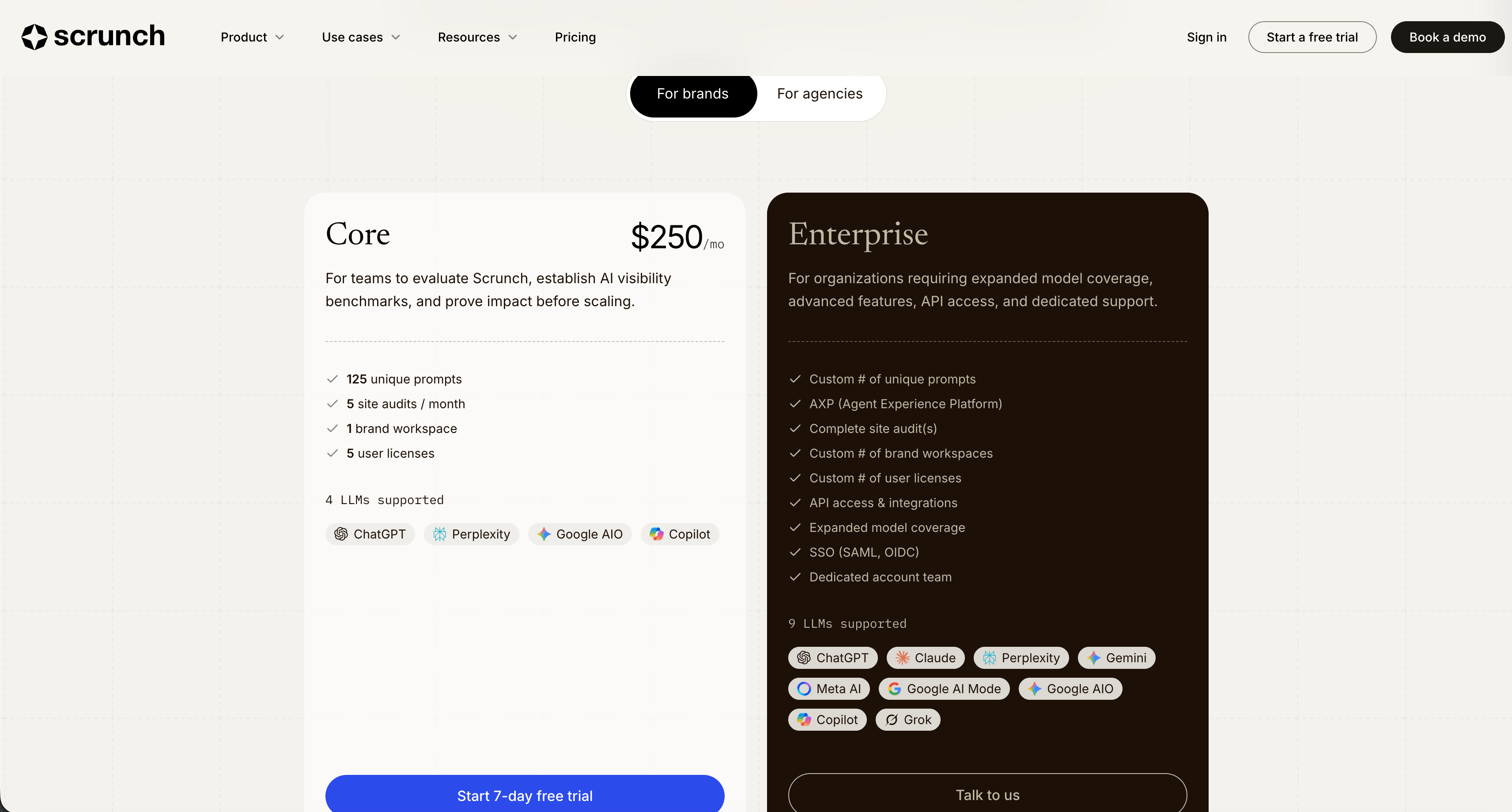
- Starter: $250/month billed annually, $300 month-to-month. 3 user licenses, 350 custom prompts, 1,000 industry prompts, 3 personas, 5 page audits
- Growth: $417/month annually, $500 monthly. 5 licenses, 700 custom prompts, 2,500 industry prompts, 5 personas, 10 page audits
- Enterprise: custom, adding SAML/OIDC, an Enterprise Data API, expanded scale, and a dedicated GTM team
- Extra seats start at $25/month, and Starter can add up to five
Coverage is listed across ChatGPT, Claude, Gemini, Perplexity, Google AI Mode and AI Overviews, and Meta. Core capabilities appear on every plan: Prompt Manager, Insights, citations tracking, page audits, agent traffic monitoring, personas, and reporting. There's a 7-day Starter trial.
What the metering tells you
Two things stand out, and both point at the same buyer.
Scrunch meters personas, which almost nobody else in this category does. A persona is a modeled customer with a distinct set of questions, and you use it to see how the answer differs for a CFO versus a practitioner. That's a research posture. It assumes somebody on your team will sit down and think about journeys.
Scrunch also charges per seat, three on Starter, five on Growth. Seat pricing in a measurement tool assumes multiple people log in. Otterly gives away unlimited seats because it expects one person to check a scoreboard.
Then there's AXP, the Agent Experience Platform, which generates an AI-friendly version of your site for agent traffic. That's a different bet from monitoring. It's an infrastructure play on the assumption that agents, not people, become a meaningful share of your traffic.
Honest read: if nobody on your team is going to build personas or think about agent experience, you're paying $250/month for monitoring you can get for less. The persona layer is the reason to pick it, and the only reason.
Scrunch AI: pros and cons
| Pros | Cons |
|---|---|
| 9 engines at Enterprise, including Claude and Grok | 125 prompts at entry |
| AXP builds an AI-readable version of your site | 4 engines on Core; Claude and Gemini are Enterprise |
| Site audits included on both tiers | AXP and API access are Enterprise only |
| 5 user licenses on the entry plan | Enterprise is quote-only |
Which one should you pick
- Team with a real AEO program and someone to ship the fixes: Goodie. That's the case the loop is built for.
- Enterprise needing all 12 engines, multi-brand, custom attribution: Goodie Enterprise or Scrunch Enterprise. Both are sales conversations.
- In-house team watching four engines, needs it in their own dashboards: Otterly Standard at $189, or $416 with all seven engines.
- Team that will model buyer journeys and cares about agent traffic: Scrunch. Personas and AXP have no close substitute at that price.
- Agency with many clients: Goodie's Agency Growth at $350/month annual bundles pitch workspaces with full client workspaces. Otterly's Agency Partner program on Standard or Premium adds prompts and client workspaces. Scrunch publishes a separate agency track. Price all three against your client count before you commit.
- Solo marketer or first-timer, testing a hypothesis: Otterly Lite. $29, fifteen prompts, no sales call. Don't overbuy at this stage.
What to ask all three before you sign
Four questions, in order of how much money they'll save you.
- Which engines are included, and which are billed separately? This is the single biggest gap between sticker and real cost.
- How do you count a prompt, and how many responses does one produce per month? Ask for the response number. If they can't give it, that tells you something.
- What's metered per seat? Seat costs compound fastest as a team grows into a tool.
- Does the trial cover the tier I'm evaluating? Trials frequently run on the entry plan while the feature you're buying for sits two tiers up.
Then run the same ten prompts through all three during the trial windows and compare what comes back. Vendor demos use prompts the vendor chose. (Mine included.)
The category is eighteen months old, and it shows
Every vendor here defines a prompt differently, and the reviews ranking above them are quoting prices that expired months ago. That's the real state of AEO buying right now.
Buy for the stage you're actually at, and check the number again on the day you sign. Everything above will have moved by winter.
FAQs



