
Most AEO reporting measures whether you got cited. That's the easy half. Whether any of it moved the business, the half your CMO actually cares about, almost nobody reports honestly.
Here's what makes that gap expensive. When we analyzed 117,432 B2B leads, the leads that originated in AI search closed at a 56.3% higher rate than the same brands' Google and Bing leads. On top of that, ChatGPT was the single highest-closing source at a 4.08% close rate, nearly double traditional search. AI search isn't just more traffic. It's better-converting traffic. And most teams still can't tell you what it did for their pipeline last quarter.
They can tell you they "got cited in ChatGPT." They can't tell you whether that citation was worth a dollar. When the CFO asks why marketing is spending time on AEO, "we show up in Perplexity now" doesn't survive a budget review.
That gap is the whole problem with how we measure AEO today. People track the easy half, presence, and skip the hard half, revenue. Here's how to close that gap.
How do you measure AI search visibility?
Measure it on three layers:
- Presence: Are you in the answer, and at what share of voice per model?
- Citation: What is getting pulled in, and how often is your brand named?
- Revenue: AI referral sessions, conversions, and revenue.
There’s no single trustworthy "AI visibility score." Track share of voice by model, treat AI referral traffic as a floor because analytics undercount it, and report the trend.
Why AI search visibility measurement is different from SEO measurement
For twenty years, the scoreboard was simple. Pick a keyword, check your rank, watch the clicks land in Google Analytics. Position, traffic, conversions. One funnel, one referrer, one number your boss understood.
AI search breaks every part of that. There's no single results page to rank on. Your brand shows up inside a generated answer, or it doesn't, and the answer differs across ChatGPT, Gemini, and Google's AI Overviews. There's no "position 3" to hold. And most of the time the user never clicks, because the assistant already answered the question. Zero-click is the default now, not the exception. (For the fuller picture of how AEO and GEO differ from SEO, I broke that down separately.)
A lot of the value is discovery you never see. A buyer asks ChatGPT to compare three vendors, forms an opinion, and shows up a week later through branded search. AI search shaped that decision. Your last-click report gives all the credit to Google. That's AI-assisted discovery, and it's invisible to the old scoreboard by design.
So the instinct is to find the new equivalent of rank: one clean "AI visibility score" for the dashboard. Don't. A blended score hides the only thing that matters. You can dominate Perplexity and be invisible in ChatGPT, and those are different problems with different fixes. Average them and you throw away the diagnosis.
The scoreboard isn't one number anymore. It's three layers.
The measurement ladder: Presence, Citation, Revenue
Every metric worth tracking sits on one of three rungs. Each answers a different question, lives in a different place, and carries a different honesty caveat. Climb them in order. A brand with no presence has nothing to attribute, and a brand with great presence and no revenue signal has a story it can't sell internally.
I call it the measurement ladder because the order is the point. You earn the right to talk about revenue by first proving presence and citation are trending the right way.
Layer 1 — Presence: are you in the answer?
Presence measures whether AI engines put you in front of a buyer who asks a relevant question. It's the layer closest to old rank tracking, and the one people over-index on because it's easy to move and easy to screenshot.
What matters here: share of voice by model (of all brands that could be mentioned for your tracked prompts, what percent of mentions are yours, per engine), visibility score (a composite trend line, useful to watch, useless as a target in isolation), position rank when cited (first-named carries the weight, same as position one did), model coverage (which engines cite you at all), and prompt-level visibility (which specific buyer questions you win or lose, where the roadmap comes from).
Add competitor visibility to this layer explicitly. Your share of voice only means something against a named competitive set on the same prompts. "We're at 6%" is noise. "We passed our two closest competitors on the ten prompts that map to purchase intent" is a report.
The per-model split is non-negotiable. Platform coupling is real: the model citing you in Grok is often not the one citing you in Gemini, because they pull from different sources. One blended number tells you nothing you can act on.
Layer 2 — Citation: what's getting pulled, and on which models?
Presence says you showed up. Citation says how, where, and whether it was actually you the model credited.
Track citation share (the percent of source citations across your tracked answers that point to your domains, per model, your earned-media metric for AI search), brand mention rate, and the one distinction most teams miss: citations-with-brand-mentions. A model can name your brand without citing your site, and cite your site without naming your brand. The overlap, citations that also mention you, is the closest thing AI search has to a branded, attributable impression. Add sentiment, because a mention with souring tone is a fire, not a trophy. Then slice everything by topic and source domain so you know which third-party sites (review pages, Reddit, publications) the models lean on to describe your category. Those domains are your AEO earned-media target list.
The caveat that trips up every deck: a mention is not a link, a link is not a click, and none of the three is a customer. Citation is an influence metric. Don't let it quietly stand in for traffic.
Layer 3 — Revenue: is AI search moving the business?
This is the layer that gets AEO funded and the one almost nobody reports, because it's the messiest. It's also the only one your CMO truly cares about. It works in two steps.
First, the traffic on-ramp: AI referral sessions. Visits where the referrer identifies an AI product (ChatGPT, Perplexity, Gemini, Claude, Copilot). This is the bridge from influence to your site.
Then, revenue: conversions and revenue tied to those sessions, plus assisted conversions. Connect AI referral sessions to signups, pipeline, or orders, and you'll usually find AI traffic converts far above its share of volume. That's the pattern the 117K-lead study showed: the buyer did the research inside the chat before they ever clicked, so they arrive pre-qualified. And because AI search often assists rather than closes, last-click attribution hands those sales to whatever channel got the final click. Look at assisted and multi-touch paths, or you'll undervalue your own work.
Here's the honesty this layer demands. The number you get will be too low. Structurally, probably low. Which is the next two sections.
How to track AI referral traffic in GA4
Start with what GA4 now gives you for free, then fix what it misses. On May 13, 2026, Google added a native AI Assistant channel to GA4's Default Channel Group. Referrals from ChatGPT, Gemini, Claude, and a handful of others now get classified automatically under the medium ai-assistant, no setup required. That's real progress, and it's a floor, not the full picture, for three reasons: it only applies going forward, so it doesn't backfill your history; it reads the referrer header, so anything that arrives without one still lands in Direct; and its coverage is incomplete and inconsistently documented, with Perplexity, one of the highest-intent sources, reportedly still dropping into Referral.
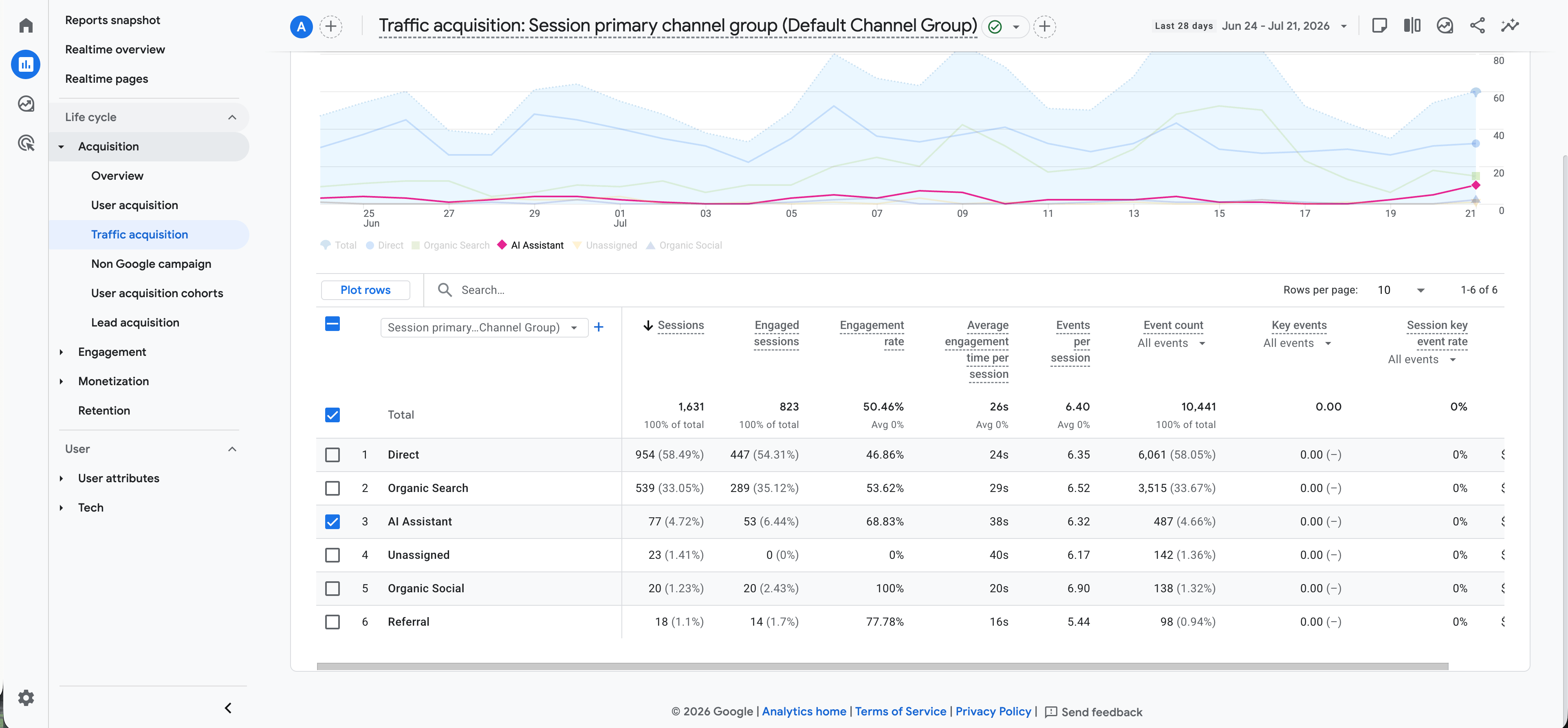
So the native channel is your starting line, not your finish line. Build a custom channel group you control on top of it, one that pattern-matches the AI referrers you care about and sits above Referral in your channel priority order. GA4 evaluates channel rules top-down, so if your AI rule sits below Referral, an AI source hits the Referral rule first and gets miscategorized. Rule order, not your regex, is the usual reason a freshly built custom group still shows AI traffic under Referral.
A few realities to know while you set it up:
- Perplexity is easy to catch, but the native channel may miss it. It passes its referrer consistently across desktop and mobile, so a custom rule picks it up cleanly. Don't assume the out-of-the-box AI Assistant channel already counts it.
- ChatGPT is partial. Desktop citation links usually carry a source tag; mobile-app clicks and copy-pasted links pass nothing and land in Direct.
- AI Overviews are hidden by design. Google bundles AI Overview clicks into Organic Search in GA4, and Search Console still gives you no clean click filter to separate them. You get AI-presence signals in GSC, not AI-click numbers.
- Referrer-based means incomplete. Both the native channel and your custom group read the referrer, so both miss the sessions that never carried one. That gap is the next section.
Use the native channel, layer your own custom group over it, tag your AI-driven links with UTMs where you can, and add server-side logging if you have the engineering to recover a chunk of what the referrer misses. Verify the classification with a real click from each tool in your own property, because this behavior keeps changing. Then read the whole thing as a floor.
The attribution problem nobody wants to put in the deck
Take one thing from this piece: your measured AI referral traffic is a floor, not a total. Report it that way every time.
The reasons are mechanical, not fixable with a prettier dashboard. Referrers get stripped when someone taps a link inside a mobile AI app or copies a URL out of an answer, so those sessions land in Direct with no fingerprint. A large share of AI-driven visits arrive this way. Nobody can tell you the exact fraction, and anyone who hands you a confident single number is guessing. It's big enough to matter. Add zero-click, where the model answers and no session is ever created, and you're influencing decisions you can't count at all.
Three more honest lines that belong in every AEO report:
- AI referral traffic is not the full value of AEO. The traffic is the visible tip. The influence, the zero-click brand-forming and the assisted paths, is the larger, unmeasured part.
- More citations do not automatically mean more revenue. Citation share can climb while revenue stays flat if you're winning informational prompts and losing purchase-intent ones. Watch which prompts you win, not just how many.
- One model is not the whole market. Dominating ChatGPT while ignoring Gemini and AI Overviews is a partial win reported as a total one.
So stop pretending. Measure the floor with the best setup you can build, say plainly that it's a floor, and use presence and citation as the leading indicators that the floor is rising. A CMO told the honest version trusts your next number. One handed a confident, precise, wrong figure stops trusting you the first time it breaks. Directional proof beats fake precision.
How to report AI search visibility to leadership
Executives don't want your metric zoo. They want three answers, in order: are we winning the AI answer for the questions our buyers ask, is that turning into brand and traffic, and is it worth money. Build the dashboard around those, one trend per line, quarter over quarter.
A CMO-ready dashboard has eight parts:
- Executive summary. Two sentences. What moved and whether it's working.
- Model-level visibility. Share of voice trend for the two or three engines that matter to your buyers. Not a blended score.
- Citation rate. Citation share trend, your AI earned-media line.
- Share of voice vs. competitors. You against your named set on the same prompts.
- AI referral sessions. With the floor caveat stated once, plainly.
- Assisted conversions. So AI-influenced revenue isn't handed entirely to last-click.
- What changed. Plain English on the delta and the likely cause.
- What the team should do next. The one or two prompts or topics to go win.
Three rules keep it honest. Report trends, not snapshots ("share of voice up from 2% to 3.4% this quarter" beats a bare decimal). State the attribution floor once, in a single sentence, then move on. And set the cadence to the data: presence and citation are worth a monthly internal check, revenue and the board version are quarterly. Don't report revenue attribution weekly, the noise will eat the signal. And never merge AEO into your SEO report as one line, they move independently now.
The metrics to stop reporting
Some numbers feel like progress and measure nothing:
- Raw mention count with no denominator. Share of voice, not count.
- A single blended visibility score as your headline. It hides the per-model diagnosis, which is the actionable part.
- "We rank #1 in ChatGPT" from one hand-typed prompt. One prompt on one day is an anecdote. Answers vary by phrasing, session, and model version. Track a stable prompt set or don't claim it.
- Impressions or "AI reach" with no path to conversion or brand lift. If it can't connect to influence or revenue, it's decoration.
What 90 days of AEO progress can realistically look like
This is an illustrative example, not a benchmark and not a promise. The shape is the point, not the numbers. Your trajectory depends on your category, your starting content, and how competitive your prompt set is.
Say a mid-market B2B brand starts today, invisible on the ten prompts that map to how buyers actually shop its category.
Month one is baseline and plumbing. You lock a stable prompt set, start tracking share of voice per model, and stand up the GA4 custom AI channel. The first read is humbling on purpose: share of voice near zero on the priority prompts, citation share low, AI referral sessions barely registering. That's the honest floor you'll measure everything against.
Month two is the leading indicators moving. After entity and content work on the prompts you're losing, presence ticks first. Share of voice climbs on two of your three target models while the third lags. Citation share rises as the engines start pulling your pages. No revenue story yet, and that's fine. Presence and citation are supposed to move before traffic does.
Month three is the first business signal. AI referral sessions become a visible (if undercounted) line in GA4, and you tie the first handful of assisted conversions to them. You still can't produce a clean last-click ROI number, and you shouldn't pretend to. What you can show leadership is a clear trend: invisible to present, present to cited, cited to the first measurable pipeline touch, in a quarter.
That arc, floor to leading indicators to first revenue signal, is what working looks like. The specific numbers are yours to earn.
How to implement this without kidding yourself
You need three things working together, because no single tool sees the whole ladder. For Presence and Citation, a prompt-monitoring or AI visibility platform that surfaces the prompts your buyers actually ask and tracks how each model describes and cites your brand, with share of voice, citation share, and sentiment per engine. For Revenue, GA4 plus your CRM: the custom AI channel group, conversions and revenue tied to those sessions, assisted paths on, ideally with attribution that connects visibility to revenue. And server-side logging where you can build it, to recover referrer-stripped traffic GA4 will never show. If you want to compare the category before you commit, I keep a running buyer's guide to AI visibility monitoring tools.
Disclosure: this data comes from Goodie, the AI search visibility platform I’m building. I’m using it here because it is one of the few datasets we have that connects AI search traffic to pipeline outcomes, but the broader point does not depend on one dataset: AEO measurement has to connect visibility to business impact.
Set it up once, keep the prompt set and channel definitions stable, and let the trend accumulate. The teams that win AI search over the next two years won't have the prettiest dashboard. They'll be the ones who measured honestly early, caught the trend while it was small, and could prove it to the person holding the budget. Watch your branded search demand while you're at it, because as AI answers form more opinions, more of the payoff shows up as people arriving already knowing your name.
FAQ



