
TL;DR
- The best-run brands of 2026 are centering the human experience in every decision: faces over logos, craft you can see, physical spaces you can walk into, and values you can feel but with AI running behind the scenes. Half of U.S. consumers now say they'd rather do business with brands that keep GenAI out of their ads.
- Outside tech-bro circles and VC X, AI is bringing most people more anxiety and fear than joy or multiples. The labs spent years marketing it that way, and it worked. Meanwhile, AI slop is piling up across the internet. These forces have an impact on how content, AI or not, and brands are perceived.
- The AI labs know it too. Anthropic’s latest ads feature real problem solvers and hand-illustrated details. OpenAI buys TV spots shot on film with human directors. Meta gave its agent a plush mascot named Jolly. At every step, the people closest to the technology are buying the most human marketing money can buy.
- Human-first is also machine-first. When AI cites a LinkedIn feed post, personal profiles are cited 73% of the time according to Goodie's 2026 data, and YouTube, Reddit, and LinkedIn have become a vital part of how AI models construct answers. The data is clear, models quote people, not AI slop.
I run a growth agency, as AI native as it gets and I founded an AI company whose job is measuring how models like ChatGPT, Gemini, Claude talk about brands. Both experiences have made one fact clear to me: the highest-return marketing decision you can make right now is to put humans in front and keep the machines in the back.
This isn’t about returning to simpler times or ignoring such a transformative technology. It’s about how and when to use it, more importantly when not to and the importance of centering the human experience in every brand decision.
So what is anti-AI marketing? It’s the choice to put people in front of every moment a customer can feel, and keep AI behind the scenes everywhere else. Few brands are actually against AI. They’re against looking like they replaced people with it.
The sentiment the Valley doesn't want to read
AI went from exciting to exhausting in about 18 months.
Pew has asked Americans the same question since 2021. Back then, 37% said they were more concerned than excited about AI in daily life. By 2025 it was 50%. By mid-2026, it was 52%, with just 9% more excited than concerned. Among younger adults (under 30), the cohort the industry assumed would be their biggest adopters, 55% are now more concerned than excited and 73% expect AI to mean fewer jobs.
That fear was manufactured, and it was manufactured on purpose. In 2024, a startup called Artisan put "Stop Hiring Humans" on billboards across San Francisco, then New York. Its CEO later admitted it was ragebait, and KRON4 put the spend at about $2 million. This year the company swapped their motto to "Be More Human," and apologized.
Duolingo's CEO wrote an "AI-first" memo in April 2025 about phasing out contractors for work AI could do. In response, users filmed themselves deleting the app, and on the next earnings call he connected softer user growth to the backlash.
And trust in AI and the future of work is at an all-time low. Edelman's 2026 Trust at Work report found 77% of employees globally worry about losing their jobs to automation and offshoring, and trust in "my employer" fell for the first time since 2021. The main 2026 Barometer lists generative AI among the five events most affecting trust over the past five years.
And platforms are already reacting to this shift. LinkedIn added a "Seems like AI slop" button this year and more than a million people have already clicked it. YouTube now demonetizes AI used as a shortcut rather than a tool. And Substack built an AI detector so readers can check how human a post is. By the time distribution channels are labeling your output, audiences are already fed up.
So put yourself in your customer’s shoes. Billboards are telling them they're replaceable. Their feed is full of six-fingered Santas. The data center debate is at the heart of politics. And then your brand shows up with another AI-generated ad and asks for their money.
That’s how AI became cringe for most. It got marketed as a threat and delivered as slop.
What the AI companies know that you don't
Watch what the labs do, not what they say.
When Anthropic launched its first brand campaign "Keep thinking," in September 2025, it didn’t look like tech. The 90-second film, directed by Daniel Wolfe, showcases real engineers, artists and conservationists. While their out-of-home posters featured actual Anthropic researchers alongside the creators of the Poetry Camera. The visual system uses warm terracotta, serif type, and hand-illustrated doodles. In a category where everything looks factory-built, Anthropic feels distinctly handmade, allowing them to claim their title as the human-centric AI company.
Then in February, they spent Super Bowl money on four spots with one line, "Ads are coming to AI. But not to Claude," and a blog post arguing that a conversation is a different kind of space than a search box. Sam Altman answered within a day with a long post on X calling the ads dishonest. But nobody writes a manifesto to debunk an ad that missed.
OpenAI's reaction was telling. Its largest-ever brand campaign in late 2025 was shot on film, with human directors and real actors, and its own creative VP described the goal as connecting with people on a human level. Mark Ritson's take in The Drum was that after years of the industry proclaiming TV dead, the most advanced AI company on earth reached for 30-second spots and billboards. By June 2026, OpenAI had moved to retro-styled ads, built by Isle of Any, explicitly to humanize the brand ahead of its possible IPO.
And then there’s Meta. On September 24 at Connect, Zuckerberg introduced the mascot for Muse, its personal AI agent: a cream-colored, rosy-cheeked plush character named Jolly. The app rocketed to the top of the App Store that week, with a Tamagotchi-style “Muse Charm” keychain scheduled for December. Five days later OpenAI launched "Dots," a fleet of colorful little sidekicks, one in a beret, to run tasks in the background. The labs have decided to give their agents a cute face "amid AI doomerism."
And I'm not sure any of this works. A smiling, squishy and plush avatar in front of a product that reads your inbox and spends your money is a strange choice, and ironically child-safety groups have already objected to a toy-like mascot on an 18+ product.
But read beneath the tactic and a broader signal emerges. The companies with the best models in the world are investing in illustration, nostalgia, taste, history, mascots, film, and real faces. They are trying to manufacture intimacy because their products don't have any.
Call it the intimacy deficit. The further a company’s product sits from human connection, the more it spends to simulate it. If the labs are buying human craft to sell machines, what exactly is your argument for using machines to sell your human brand?
The 37-point gap: why AI slop ads backfire
The industry is adopting AI in creative faster than audiences are warming to it.
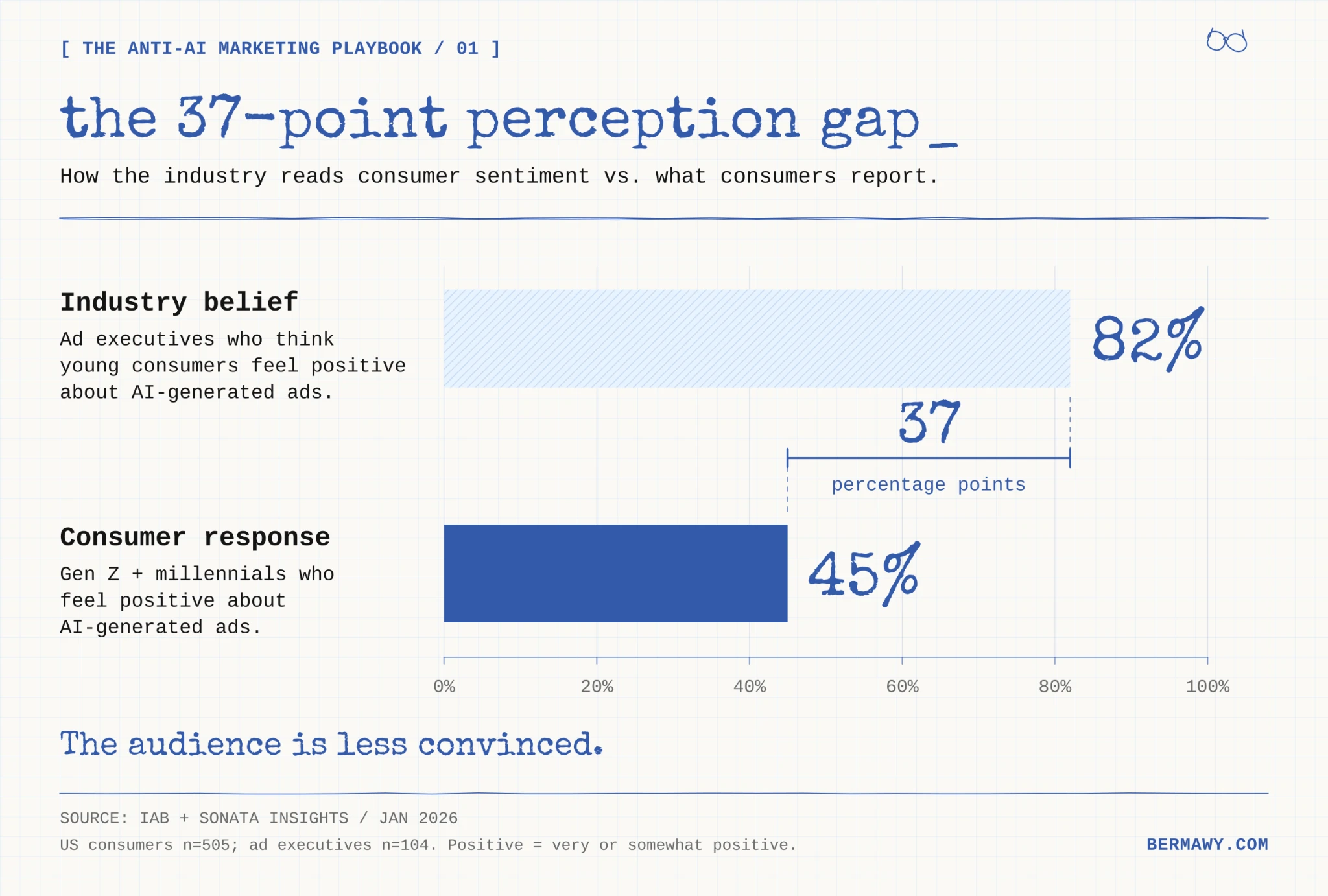
IAB and Sonata Insights surveyed 505 Gen Z and millennial consumers and ad executives between October 2025 and January 2026. 83% of executives said their company has deployed AI in the creative process, up from 60% in 2024. 82% of them believed young consumers feel positive about AI-generated ads. 45% of consumers actually did. That's a 37-point gap, up from 32 points two years earlier.
The share of young consumers who feel negative about AI ads went from 18% to 30% in two years, and consumers were twice as likely as executives to call brands that use AI in ads "manipulative."
Gartner found the same thing in a broader sample. Of 1,539 U.S. consumers surveyed in October 2025, 50% said they'd prefer to do business with brands that don't use GenAI in consumer-facing content, and 68% frequently wonder whether what they see is real. In our own 2026 survey of marketers, 76% said finding out a brand used AI-generated visuals changes how they see it, for the worse.
It has reached the point where even real work gets accused of being fake. Aritzia's oversized shopping bags riding a conveyor belt through a mall and KFC's pickle-brine puffer jacket were both real, and both were flagged as AI within hours of posting. People have stopped trying to detect and just started assuming.
And trust is as important to consumers as price, if not more. If you need a data point to believe it, Edelman's 2026 brand report: 88% say trusting a brand is an important or critical reason to buy.
The best known examples of AI slop in advertising follow the pattern exactly. Coca-Cola's AI remake of "Holidays Are Coming" drew backlash in 2024, and the company did it again in 2025 and got the same result, boycott calls included.
McDonald's Netherlands posted a fully AI-generated Christmas film on December 6, 2025 and had it down by December 10. And fashion brands like Guess, J.Crew and Valentino all took criticism for AI-generated models and imagery in 2025. Svedka ran what was billed as the first primarily AI-generated Super Bowl ad in February 2026, and the reaction was polarized at best. Equinox opened 2026 with a campaign that used AI slop as the villain, then had to pull one of its own AI images in July after Asian American members said it reinforced racial stereotypes. (We wrote about it in January: using generated content to position yourself as an anti-AI brand isn't anti-AI, it's ragebait.) It reaches all the way down to a pharmacy on Capitol Hill that apologized in October 2026 for AI-generated marketing after a Reddit thread drew more than 1,100 comments.
Notice what each story has in common. In every case the AI was visible, it was used in a moment that carries emotional weight, and it read as a brand choosing to spend less on people. Customers don’t reject AI by default. When used correctly, it can actually make their lives easier. But when the signal reads as you’d rather not pay a human, your brand will be punished.
The human-first operating model
The brands winning right now are not banning AI, but they are being intentional with where they use it. Our social team has a word for the wider pattern: tastewashing. Tech companies use brand marketing and PR to attach themselves to art, aesthetics and the look of taste, as a direct answer to how the public feels about AI. Palantir and OpenAI both launched sold-out apparel lines last year with no throughline to the product. Google DeepMind put $75 million behind a partnership with A24 and got a backlash from A24's own audience, because you can't be the taste maker and the AI partner at the same time without someone noticing. Decide which moments are human and protect those, and automate everything around them without making a show of it. This is the human-first operating model, the core of the anti-AI marketing playbook.
1. Faces over logos
In a world where words, images, and videos can be faked, trust is concentrating in people, and specifically in people close to you. Edelman's 2026 Barometer calls it insularity: "my CEO" is trusted by 66%, coworkers and neighbors hold up, institutional voices lose ground. In the brand report, 41% say what unpaid people say about a brand has the biggest effect on whether they trust it. Only 20% point to what the brand says about itself.
That makes the brand account the weakest voice you own. Founders, engineers, designers, strategists and creators are the strongest. We’ve already seen Gap, Starbucks and Staples pull money out of influencer deals and put it into their own employees, on the bet that a staff post reads truer than a paid one and at a fraction of the cost. The clearest case this year was YSL Beauty. When a story about a misdelivered YSL gift basket went viral on TikTok, the brand account showed up and engaged. The moment that actually cut through was the employee who runs the brand's socials filming himself packing a replacement basket, from his own account.
There's a trap here, and Sprout Social's Q2 2026 data shows it. Only 8% of consumers trust brand employees for product recommendations. Yet 40% say employee content feels more authentic than the main brand account, rising to 51% among Gen Z. Read those together and it’s clear. Nobody wants your employees selling. What they do want is your employees showing their work, their interactions, and having opinions and teaching their customers. Paid proximity is cracking for the same reason: this year a Nantucket shop's handwritten "No Influencers" sign went viral, and the internet sided with the shop. The founder opens the door. The team walks through it.
2. Craft as proof
When any image can be generated in seconds, effort becomes scarce, and thus the luxury signal. In our 2026 survey, 80% of marketers said taste now plays a bigger role in shaping brand perception. Luxury houses figured this out first.
On January 2, 2026, Hermès replaced its product grid with 12 pen-and-India-ink drawings by Linda Merad, paper grain and uneven color left in on purpose, with a seahorse in a scarf as navigation. Merad told Fast Company the brief was that visitors should feel a human made this. By summer the site had been redrawn again, by Sarah Martinon with animator Armand Béraud, and Hermès' Instagram now routinely tags the artist and says how long the work took.
Prada went even further, releasing "Drawing Prada: Animated by Hand" on October 27. Every frame of the illustrated winter world around Maya Hawke, Sadie Sink and the rest of the cast was drawn by a team led by John Pomeroy, the animator behind The Land Before Time and An American Tail, and composited into Glen Luchford's photography. The press release ties the sense of touch to a basic idea of humanity, and Prada published a behind-the-scenes film to show the storyboards and the pencils. Six months earlier its spring campaign had artist Anne Collier physically holding printed photographs inside the frame, so the image itself became a held object.
Loewe marked its 180th anniversary with a film built from more than 2,000 hand-painted watercolor frames, narrated by Antonio Banderas. Chanel introduced its Métiers d'art 2026 Seoul show with an illustrated portrait of the city by Jisu Choi. Burberry put its house check in the hands of a mosaic artist and a ceramicist. Business of Fashion's read in September: as AI slop floods the feed, fashion marketers are hiring painters, illustrators, sculptors and ceramicists to remind people there are humans behind the brand.
And this strategy isn’t reserved for luxury alone. Aerie pledged in October 2025 that it would never use AI-generated bodies or people, extending its 2014 no-retouching promise. The post became its most popular on Instagram in a year, engagement on its feed grew about 75% in the following two weeks per Metricool, and the 2026 campaign with Pamela Anderson carries labels that read "shot by real people." Polaroid put "AI can't generate sand between your toes" on billboards next to Apple Stores and Google offices. iHeartMedia built "Guaranteed Human" into every station's hourly ID. Almond Breeze opened 2026 with the Jonas Brothers turning down a pitch for AI-made ads.
Smaller signals are spreading too: typos left in on purpose, risograph grain, hand-lettered type. With AI, polish is now cheap, while human errors are the one thing a model can’t produce.
Notice how no one claimed to never touch AI. Each drew a narrow, provable line around the thing their customer cares about (real bodies, real drawings, real voices) and owned it. A vague "no AI slop" promise means nothing anymore. But a specific one, backed by repeated actions, compounds.
Elevate your artists. Credit the illustrator, the photographer, the person who mixed the audio. Show the hands.
3. Rooms over reach
The strongest brand moments of the past two years happened in rooms, not feeds.
Ralph Lauren has run Ralph's Coffee since 2014 and now has more than 40 cafes worldwide. Capital One runs 65, and Uniqlo and Coach have joined in. A bank and a fashion house are in the coffee business for the same reason: a $7 latte is the cheapest way to get someone to spend 30 minutes inside your brand, with their phone down.
And budgets are following across industries. EventTrack 2026, Event Marketer and Sparks' survey of more than 1,000 Fortune 1000 marketers and attendees, found 84% of consumer marketers and 86% of B2B marketers planning to increase event spend this year. Supper clubs, run clubs, workshops, residencies, pop-ups, and collaborations that would have looked random five years ago (fashion and coffee, banks and cafes, beauty and bookstores) are now strategic.
You can't fake being in a room together with AI slop. And every person who leaves that room posts about it from a personal account, which is the most trusted channel there is. One dinner for 20 is 20 pieces of content from 20 real voices people trust.
4. Open the curtains
Polish used to be the goal, but it now reads as synthetic. Hermès credits the artist and the hours. Prada's behind-the-scenes film showed the pencil sketches. Anthropic put its researchers on posters, by name. The pattern is the same: show the factory floor, the test kitchen, the failed prototype, the founder on a bad day. High-quality human video, shot well but not scrubbed clean, does what no generated asset can. It proves someone is there.
Coca-Cola had the right instinct and the wrong execution. Its 2025 campaign theme celebrated the people working behind the scenes of the holidays, but then the hero films were AI slop. If your story is about humans, show the humans.
One warning. Staged candor doesn't count. Merit's messy sink, Kodak's curated TSA bin, the "accidental" coffee spill: all of these turned "authentic" moments into a performance and audiences stopped paying attention. Show behind-the-scenes work when it's proof, the way Apple filmed its new Apple TV logo through real glass to show a person made it. Not when it's a style.
5. Values alignment as the filter
Without knowing it, every customer asks themselves one question before they buy: is this a story I want to be part of?
Brands are markers of belonging too. Clear, lived values let the right customers self-select in, but vague ones don’t let anybody in.
This is why Artisan's billboards and Duolingo's memo caused a rift. Neither was just a message. Each announced a worldview in which people are a cost line, and people are disposable.
Compare that with Anthropic, which has kept the same line for four years: AI that amplifies thinking rather than replacing it, in the product, the ads, the no-ads pledge and the illustration style. Whatever you think of the company, the story doesn't contradict itself.
Write down what you stand for in plain words. Then run every campaign, partnership and AI use case against it. If a reasonable customer would read your AI decision as "we'd rather not pay a person," don't make it in public.
6. Consistency compounds
Trust forms over time. And not through campaigns, but through habits.
Aerie's no-AI pledge worked because it was the 2025 chapter of a story that started with no retouching in 2014. Hermès' hand-drawn site works because "Drawn to Craft" was its 2025 theme and drawing has been the root of its design for a century. Polaroid's anti-screen message works because the product has always been the argument. None of these brands invented a stance for a news cycle. They extended one.
You'll like ten brand memes today and remember who posted two of them tomorrow. Attention and recall are different metrics, and only one of them compounds.
The AI slop playbook optimizes for this week's CTR. The human playbook optimizes for whether someone believes you in year three. Same voice, same faces, same values, for longer than feels necessary.
7. AI in the engine room, humans in the front of house
This is the part people get wrong in both directions.
Use AI for research, analysis, forecasting, media buying, QA, versioning, transcription, localization, reporting, first drafts nobody will see, and every mundane task that eats a strategist's week. Our agency runs on it and Goodie AI exists because of it. But every hour it saves should get reinvested in human time a customer can feel.
Do not use AI in the moments where someone needs to feel another human: the holiday film, the founder's letter, the apology, the support conversation that decides whether a customer stays, the face in the ad, the illustration on the site, the dinner. And don't be flashy about where you use it. The brands that win aren't announcing their AI stack in the creative. They're using it to buy more hours for people.
Ask yourself, is this a moment of connection, or a moment of production? Production goes to the machine. Connection stays with people. The customer never has to see the line, but they'll feel it if you cross it and deem it AI slop.
8. The machines cite humans too
This is where my two jobs meet, and it's the part most marketers still miss. Human-first marketing is also how you get found by AI.
We analyzed 219,351 AI citations to LinkedIn across nine AI surfaces from January to September 2026. Personal profiles took 73% of the citations to feed posts and led the feed in 26 of 32 industries. On Google AI Overviews it was 86%. Even on LinkedIn Articles, the long-form format where company pages compete hardest, the split was close to even, and company pages led in only 12 of 32 industries.
Zoom out and the pattern holds. Our first social citation study, 6.1 million citations across 10 AI surfaces, found Reddit and LinkedIn were the only social platforms every one of those surfaces cited. By the V2 study, 45.2 million citations, YouTube (45.9%), Reddit (24.9%) and LinkedIn (11.8%) were taking more than four of every five social citations, and social content was earning about 2.5X the citations of brands' owned pages. The Social Diet follow-up tracked 1.86 million social citations across 10 surfaces and found social's share of all AI citations grew from 4.9% to 7.2% between January and August 2026, while owned content held flat around 2.5% to 2.8%.
Read that. The signals answer engines were trained on, and keep retrieving, are people talking to people: practitioners on Reddit, creators on YouTube, operators writing under their own names. A company page repeating a press release gives the model nothing new or citable. A named expert with a point of view does.
So the move that builds human trust builds machine trust. Put your people on the record, in their own words, consistently, and both audiences reward you.

Where this goes
Three years from now, the brands that scaled generative output will be indistinguishable from each other and from AI slop, because that's what infinite supply does to any signal. The brands people can name a human at will own the trust, the rooms, the citations, and the premium.
The labs have already placed their bets. They're spending on creators, illustrators, plush mascots, and film directors because they know what their products can't give people. You have customers, employees, artists and a real human story to tell.
Anti-AI marketing: frequently asked questions


