
To show up in AI search, you have to win two contests at once. Retrieval: the engine can crawl you, recognizes your brand as a distinct entity, and can parse your pages. Recommendation: given that it knows you exist, it picks you when it builds the answer. Most of the leverage sits off your own website — earned coverage, social, video, and community together outweigh any single on-page factor. So the fastest way to get named by ChatGPT, Claude, Gemini, and Perplexity isn't rewriting pages for "AI syntax." It's being crawlable, being a recognized entity, and being cited across the surfaces those engines actually read.
Most brands are optimizing the wrong half of AI search. They rewrite pages for “AI syntax,” bolt on schema, publish an llms.txt file, and then watch ChatGPT recommend a competitor anyway. The uncomfortable truth: a large share of what decides whether an AI names your brand happens off your website, on surfaces your SEO team has never owned.
I've spent the past few years inside this problem, at NoGood running AEO programs for brands and at Goodie building the platform that measures it. This year we ran the largest version of our ongoing study yet: 1.13 million prompts across six AI surfaces (ChatGPT, Claude, Perplexity, Grok, Gemini, and Google AI Mode), scored every citation outcome against a candidate factor list, and consolidated the results into fourteen factors with explicit weights. We published it as the AEO Periodic Table V4. Full disclosure: Goodie is my company, so read the data knowing that. The method and limits are published with it.
This piece is the operator's version. Not the study, but what the study tells you to do differently, starting this week.
The two games you have to win
AI visibility is two separate contests, and most programs only play one.
The first is retrieval. Can the engine access and understand you? Does it recognize your brand as a real, distinct entity in your category, from training data and from what it fetches live? Fail here and nothing else matters. You're invisible before the answer is even assembled.
The second is recommendation. Given that the engine knows you exist, does it pick you when it builds the answer? AI shortlists are short, usually three to five brands. Engines assemble answers at the passage level from many sources, and they pick what's easiest to verify, freshest, and most corroborated across the open web.
The reason this framing matters: to an AI model, your brand is more than what you say about yourself on your own site. It's the sum of everything the model learned in training and everything it retrieves at the moment it answers. Wikipedia, Reddit, YouTube, review sites, comparison pages, news coverage, podcasts. Those surfaces shape the answer as much as your own pages, often more. And in most companies, no single team owns them.
The 14 factors that decide whether AI names your brand
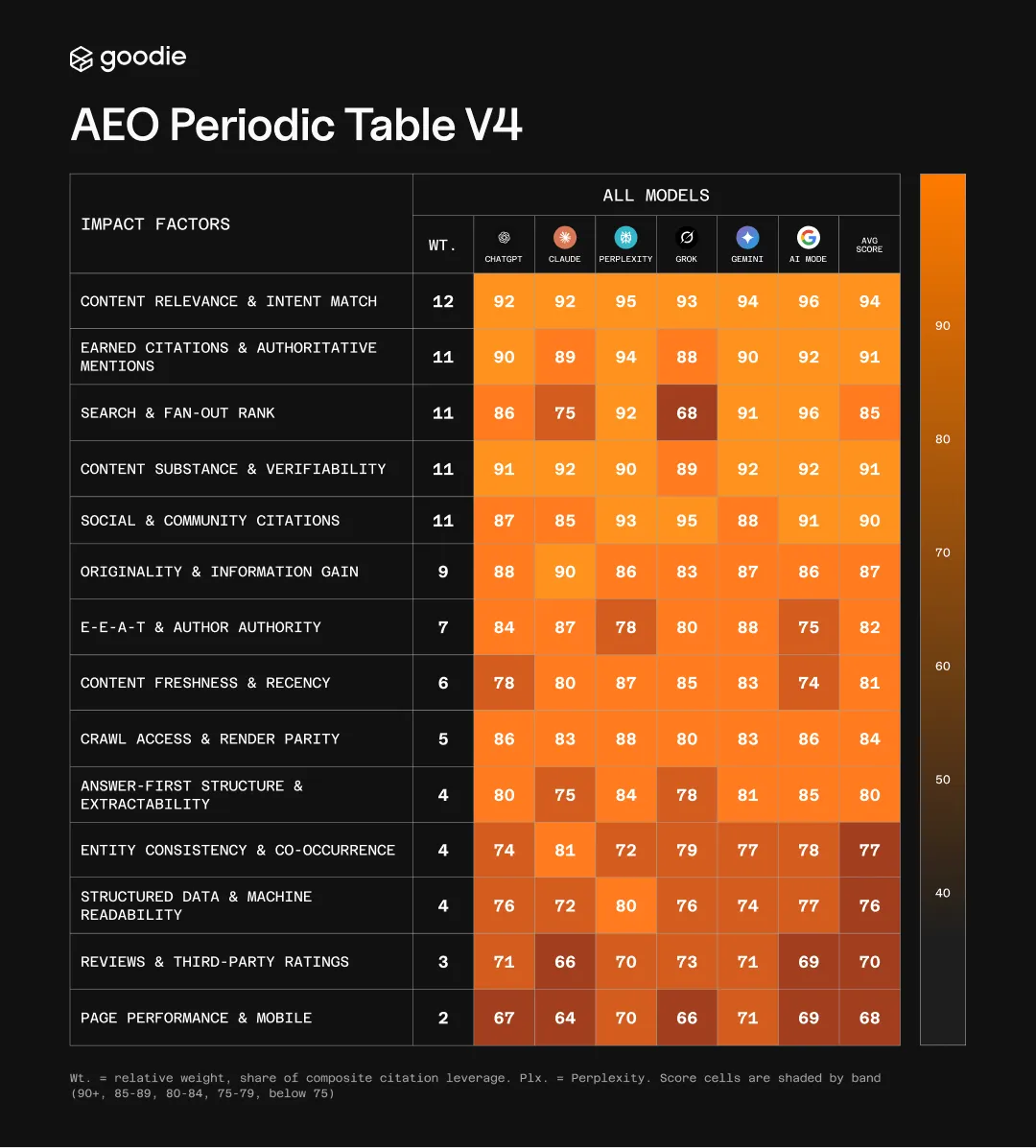
Here's the table. Weight is each factor's share of total citation leverage across all six engines (they sum to 100). The average is the unweighted mean of per-engine influence scores. Treat both as directional; the data is correlational, not causal.
Now map the table back to the two games. Retrieval lives in factors 9, 11, and 12: crawl access, entity consistency, machine readability. Recommendation is everything else, and it's where the weight concentrates.
Five findings in this data should change how you allocate budget. Let me take them one at a time.
Finding 1: Off-site citations hold 22% of the leverage, and almost nobody is resourced for it
Earned Citations (weight 11) and Social & Community Citations (weight 11) together hold 22% of total citation leverage. That's more than any single on-page content factor. Most SEO-derived programs run the exact inverse: the overwhelming majority of effort on owned pages, a thin slice on the off-site corpus.
Our earlier social citations research put a number on the gap: social content drives between 2.31x and 4.17x more AI citations than owned content, with video, led by YouTube, taking the largest single share. The mechanics make sense once you think about it. A model can't watch a video, but it can read the transcript, and a 15-minute YouTube video is thousands of words of dense, structured human speech. Exactly the kind of material engines lift.
This is the clearest arbitrage in the whole framework. If your AEO effort is more than 70% on-page content work, you're mismatched against the data. Stop treating earned media and social as brand-awareness line items and start treating them as retrieval infrastructure.
Finding 2: Search rank is the strongest correlation, and the most misunderstood
For engines that ground on live search, organic rank is the best single predictor of citation we can observe. Search & Fan-out Rank scores 96 on Google AI Mode and 92 on Perplexity. Any framework that ignored it would be dishonest.
The trap is treating rank as a lever. It isn't. Rank is downstream of relevance, authority, structure, and freshness. It's the scoreboard those inputs produce, not a dial you turn on its own. Same story with domain authority, the perennial debate: some analyses find it among the strongest predictors of citation, others find almost none. The reconciliation is that authority is a proxy too. It rises alongside the things that actually cause citations: entity recognition, earned coverage, primary-source presence. Optimize for the causes and the proxy follows.
And notice the variance across engines. Rank scores 96 on AI Mode and 68 on Grok, which grounds on its own ecosystem and X instead of the open search index. That gap alone tells you a single “AI strategy” averaged across engines leaves citations on the table everywhere. More on that below.
Finding 3: Originality beats schema by a wide margin
Originality & Information Gain carries a 9% weight and an 86.7 average. Structured Data carries 4% and 75.8. A brand publishing schema-rich but derivative content underperforms a brand publishing schema-light original research, by a wide margin.
Marketers love schema because it feels like a control you can turn. Do it once, for parsing and rich results, then stop. The most rigorous 2026 tests show engines read the visible HTML during retrieval and largely ignore the JSON-LD. Schema doesn't manufacture citations. What manufactures citations is saying something the internet doesn't already say: proprietary data, first-hand results with real numbers, a genuine position. If a model could reconstruct your article from three existing pages, it has no reason to cite you over them.
Finding 4: Answer placement helps; the rest of the “rewrite for AI” advice is overstated
Leading with the answer and keeping statements self-contained gives a real lift. Models retrieve passages, so structure matters, and Answer-First Structure earns its place on the table at a 4% weight.
But look where it sits: well below substance, originality, and authority. The broader rewrite-everything posture, the chunking, the “AI syntax,” the restructuring of long-form editorial into robotic blocks, runs past the evidence. In our data those moves often correlate more with the search rank and content quality underneath them than with the rewrite itself. Reference and how-to content responds to sharper answer-first structure. Long-form editorial rarely does, and sometimes loses something in the rewrite. Write clearly, put the answer near the top, move on.
Finding 5: The engines disagree with each other, architecturally
The per-engine columns are the point of the study, so here's the split that matters most. Claude (87) and Gemini (88) weigh author authority significantly higher than Perplexity (78) and AI Mode (75). Freshness runs the other way: Perplexity (87) and Grok (85) reward recency far more than AI Mode (74) or ChatGPT (78).
The reason is architectural. Conservative, training-leaning engines privilege credentialed, durable sources. Aggressively live-grounding engines prioritize what's current. A strategy tuned for Perplexity needs an update cadence; one tuned for Claude needs depth and credentials instead.
How I brief teams on each surface:
ChatGPT leans on what it learned in training. Being a recognized, well-covered entity matters as much as any single page. Win the canonical sources: Wikipedia, the consensus explainer pages, the entity graph. Live search supplements that base rather than replacing it.
Claude is the most conservative engine. It cites the fewest sources per answer and rewards depth, verifiable credentials, and primary-source material. Thin or derivative content rarely makes the cut.
Perplexity grounds aggressively on live retrieval. Community platforms and recent earned coverage run hot; current, well-structured pages and listicles outperform evergreen owned content.
Gemini and AI Mode track conventional rank and fan-out closely. AI Mode breaks a query into sub-questions and synthesizes across them, so one thorough page that answers a question and its related sub-questions beats several narrow keyword pages.
Grok lives on X. A brand with no presence there is largely absent from Grok answers regardless of how strong its site is.
Audit by surface, not by tactic. Measure your visibility on each engine separately, because each has a different leading factor, and a program built around the average underperforms one built per engine.
The gate before all of it: robots.txt
One line of configuration outranks everything above, because its effect is binary. If your robots.txt blocks an engine's crawler (GPTBot for ChatGPT, ClaudeBot for Claude, PerplexityBot for Perplexity, Google-Extended for Google's AI surfaces), you're invisible to that engine no matter how strong the other thirteen factors are. It sits inside Crawl Access on the table because it earns no citations on its own, but audit it first. Plenty of sites blocked AI crawlers defensively in 2023 and 2024 to keep content out of training, and in doing so quietly removed themselves from live citations too. Training crawlers and retrieval crawlers are different bots; you can block the former and keep the latter open.
While we're on machine-facing files: llms.txt has no proven effect on citations today, and Google has said it doesn't use it. I'm more optimistic about it than the prevailing dismissal, but only as documentation, a readme for machines mapping a large site. It costs little and doesn't hurt. Just don't confuse it with a visibility lever. The file actually worth watching is agent.md, which governs how AI commerce agents transact with a store rather than how engines cite content. Shopify now auto-generates it for agentic storefronts. If you sell through AI, that's becoming table stakes, and it's a separate workstream from everything in this piece.
Your AI search strategy, in order of leverage
- Audit robots.txt today. Confirm GPTBot, ClaudeBot, PerplexityBot, and Google-Extended can reach your content, or at minimum that retrieval bots are open even if you block training bots. The binary gate comes first.
- Build a source map. Take your top 50 category prompts, run them across every engine, and record which sources each one cites. Group by domain. The output is the list of surfaces you must be present on and the ones competitors are using that you aren't. Higher leverage than any single-page optimization.
- Rebalance toward off-site. Move real budget to earned coverage and social, with YouTube long-form and the community threads that actually get cited at the top of the list. This is where the 22% lives and where almost no one is spending.
- Publish for information gain. Original data, first-hand case studies, a real position. Lead each section with the direct answer. Do your schema once, then leave it alone.
- Assign retrieval ownership. Programs stall because nobody owns “why aren't we showing up for this prompt.” Content and SEO own relevance, substance, originality, structure, freshness. SEO and engineering own rank, crawl access, structured data, performance. PR, social, and comms own earned and social citations and reviews. Brand and PR own E-E-A-T and entity consistency.
- Measure citation share by engine, over time. Click-based analytics fold AI traffic into general web traffic and can't tell you how often a given engine cites you. Track the citation layer directly and treat it as the KPI.
What this data can and can't tell you
Two things to keep in your head. The data is correlational; citation outcomes are shaped by factors that move together and can't be fully isolated from observational data, which is why the weights are directional rather than precise to the decimal. And engines change how they retrieve and ground answers often. Any snapshot has a shelf life, which is exactly why this is the fourth edition of the table and won't be the last. Re-measure on a cadence, the way an analytics team rebuilds attribution models.
But the durable moves are clear enough to act on now. Be crawlable. Be a recognized entity. Earn coverage off your own site, especially video and community. Publish something only you can publish. Lead with the answer. And stop optimizing for “AI” as if it were one engine, because it's at least six, and each one wants something different. Get those right and you stop asking why the AI recommends your competitor.
FAQ



