
Attribution is AEO’s biggest challenge so far. AI search revenue attribution tools connect brand exposure in AI answers (ChatGPT, Google AI Overviews and AI Mode, Gemini, Claude, Copilot and others) to traffic, conversions and revenue. I’ve been obsessing over AI search measurement. Here are the best ones in 2026: Goodie AI, Triple Whale, Northbeam, Fairing and Adobe Brand Visibility. They differ on one question: how they handle the majority of AI influence that never produces a click.
Most of what AI search does for your brand is invisible to your analytics. A buyer asks ChatGPT for the best option in your category, sees you recommended, closes the tab, and shows up three weeks later as a branded search or a Direct visit. The AI answer that did the persuading gets nothing. The channel is small in sessions and large in value: Adobe Analytics found AI-referred shoppers to US retail sites converting at a 60% higher rate and generating 53% more revenue per visit than other traffic in July 2026, with AI-referral traffic up 1,219% since October 2024.
Semrush's June 2025 study put the average AI search visitor at 4.4x the value of a traditional organic visitor on conversion rate. In Goodie's analysis of 117,432 B2B leads from October 2024 to April 2025, leads that started in AI search closed at a 56.3% higher rate than leads from Google or Bing, with ChatGPT posting the highest close rate of any source at 4.08%.
AI search attribution tools at a glance
| Tool | Primary job | Observed (referral) attribution | Modeled zero-click influence | Survey layer | Experiments | AI visibility monitoring | Entry price |
|---|---|---|---|---|---|---|---|
| Goodie AI | AEO platform with attribution at the core | GA4, Adobe Analytics, CRM, Shopify | Yes, by model, shown as a range | Yes | Planned | Yes, up to 14 engines | $295/mo published |
| Triple Whale | Ecommerce attribution with AI visibility added | Triple Pixel | No | Yes, post-purchase | Via Compass | Yes, 5 engines | Free tier |
| Northbeam | Paid-media measurement (MTA, MMM+, incrementality) | First-party pixel, ML MTA | Channel-level ML only | No | Yes | No | About $1,500/mo |
| Fairing | Post-purchase survey attribution | No (feeds GA4, Triple Whale, Rockerbox) | No | Yes, this is the product | No | No | Free up to 200 orders/mo |
| Adobe Brand Visibility | GEO inside the Adobe stack | Adobe Analytics, CJA | Not disclosed | No | No | Yes | Sales |
Status as of October 25, 2026. Verify against each vendor before you buy.
What is AI search revenue attribution?
AI search revenue attribution is the practice of tracing a brand's presence in AI-generated answers through to the sessions, leads, orders and revenue it produces. It covers two outcomes: attributed revenue, traced through a click from chatgpt.com or perplexity.ai to a conversion, and influenced revenue, the demand AI created without a click.
SEO attribution never had to solve the second half; a Google result either sent a click or it didn't. AI answers persuade inside the engine's interface, and every tool on this list is trying to close that gap in its own way.
Why AI search is so hard to attribute
Four problems compound, and each pushes real AI influence into a bucket your analytics calls something else.
Zero clicks. The research happens inside ChatGPT or Gemini. No cookie, no UTM, no referrer. Google's AI Overviews and AI Mode don't register as a separate source at all; their clicks land in google / organic, so a slice of what looks like traditional search traffic is AI-driven.
Stripped referrers. Native AI apps and copy-pasted links drop the referrer, which pushes real AI visits into Direct. In Goodie's 2026 AI Search Traffic Report (January to April 2026), Direct averages roughly 31% of sessions across the brand panel; if even 5% of that is misattributed AI traffic, the true AI total is more than double what referrers show.
A moving target. GA4 only added a default "AI Assistant" channel on May 13, 2026, and only added Perplexity as a built-in source grouping on June 11, 2026. Any attribution model trained on channel history before those dates is learning across a break in the data. The engine mix moves too: in the same Goodie report, ChatGPT's share of measurable B2B AI referrals fell from 89.1% (May to August 2025) to 62.6% (March to April 2026), with Claude rising to 18.5%.
Small share, outsized value. AI referrals are still low single digits of sessions for most brands, yet they convert like the best traffic you have. Measure the channel by sessions and you'll under-invest in it.
The attribution ladder: how to evaluate any AI search attribution tool
Every product in this category is some combination of four rungs.
- Observed. AI-referred sessions and the revenue they produced, as your analytics or pixel recorded them. Auditable, small, and the floor of the channel.
- Modeled. Influenced revenue estimated from the lift in branded search, Direct and dark traffic that follows AI exposure. Useful when it's labeled and shown as a range. Dangerous when it's blended into the observed number.
- Reported. Post-purchase or post-lead surveys ("How did you first hear about us?"). The only independent check on a zero-click channel, with a recall bias you have to state.
- Proven. Holdouts and experiments, by geography or by rollout wave. The only rung from which anyone should say the word "incremental."
One rule protects the whole structure: a number from a lower-certainty rung never gets summed into a higher-certainty number without a label. A CFO who sees that discipline once will trust the rest of the report.
The 5 best AI search revenue attribution tools in 2026
1. Goodie AI
What Goodie AI is
Goodie AI is an Answer Engine Optimization platform for mid-market and enterprise brands that runs the full loop: prompt research, visibility monitoring, optimization actions and revenue attribution in one system. It's a software platform, not an agency, and attribution is the part of the product everything else feeds. It’s the only player that has the proof layer complete, not just monitoring.
How Goodie attributes AI search to revenue
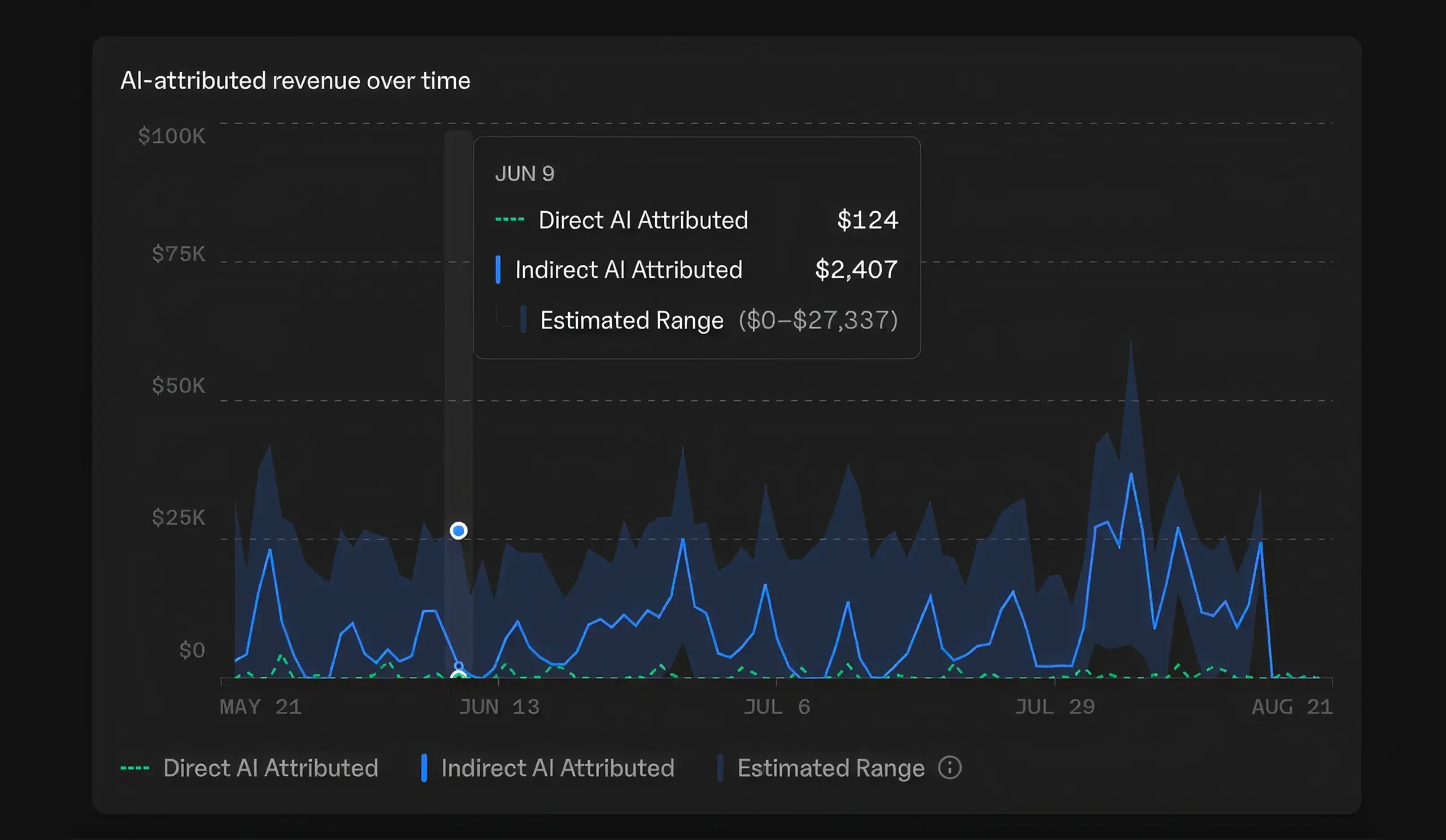
Goodie has a full measurement framework around zero click experiences. It reports two main numbers and keeps them apart. Attributed revenue is the observed rung: AI-sourced sessions identified through the Google Analytics integration, traced through lead generation, CRM and commerce data to closed revenue, and segmented by AI platform, prompt category, content theme, geography and time period. Influenced revenue is the modeled rung: the zero-click demand AI search created, estimated from lift in branded search, Direct and unassigned traffic as well as citation and agent signals against a baseline, broken down by model, and shown with an estimated range rather than a single point. Then triangulated against post-conversion survey data.
The second number is where most of the value and most of the risk lives, so here is how to read it. Goodie's own panel puts clicks at under 13% of the impact it reports. That figure is an output of the model, which means it tells you how Goodie sees the channel rather than an audited fact about yours. The in-product methodology sheet labels what's measured and what's modeled, and shows survey triangulation and experiment-based validation as planned rather than live. I'd rather tell you that here than have you find it in a QBR.
What makes the loop closed is that visibility, traffic and conversions sit in the same system. You can point to a content update, show the citation share it gained, and follow that gain into traffic and pipeline.
Engines, surfaces and data covered
Up to 14 engines on Enterprise: ChatGPT, Google AI Overviews and AI Mode, Perplexity, Gemini, Claude, Copilot, Meta AI, DeepSeek, Grok and Meta Muse, plus Amazon Rufus/Alexa for Shopping and Walmart's Sparky through the Agentic Commerce Suite, plus custom models. Core covers 5 engines and Pro covers 8. Data integrations include GA4, Adobe Analytics, Google Search Console, HubSpot, Salesforce and Shopify. On Enterprise, crawler and agent analytics pull from Cloudflare, CloudFront, Vercel and WordPress, so you see when an engine fetched a page to answer a question, the closest thing to a zero-click impression that exists today.
Where Goodie is weaker
A brand with a short or noisy analytics history gets a wider modeled range. The survey and experiment rungs are not yet in the product.
Pricing and best fit
Published entry tier at $295 per month with revenue attribution included from the first paid tier; Pro at $999 per month; Enterprise through sales. Best for brands that need to report AI search as a revenue channel across every engine and prove which optimizations moved it.
Founded year: 2023
Office: New York City, NY, US
2. Triple Whale
What Triple Whale is
Triple Whale is an ecommerce intelligence platform used by more than 50,000 Shopify and DTC brands for attribution, profit and creative analytics. On January 20, 2026 it bought Anteater, its first acquisition, and folded AI visibility into the platform that already holds your orders. It’s not an AI search native solution but certainly a key player in the attribution space.
How Triple Whale attributes AI search to revenue
The observed rung is the Triple Pixel: LLM-referred sessions that convert get attributed like any other channel across Triple Whale's seven models. The reported rung is the post-purchase survey, where you add "AI (ChatGPT, Perplexity, etc.)" as an answer option. When pixel and survey disagree, pixel wins in most models; the Total Impact model blends pixel, survey and machine learning into weighted credit.
Triple Whale has published more useful data on this than any other vendor. Merchants on the platform recorded 424,262 orders from LLM referrals in Q4 2025, against 7,152 in all of 2024, a 59x jump. Across 473,352 AI-attributed orders from December 9, 2025 to March 8, 2026, ChatGPT accounted for 97.38%, Perplexity 2.39%, with Gemini and Claude at a rounding error each. Their own survey data suggests 2.5 to 3x more orders were LLM-influenced but arrived through no trackable link. That last number is the dark half of the channel.
Engines, surfaces and data covered
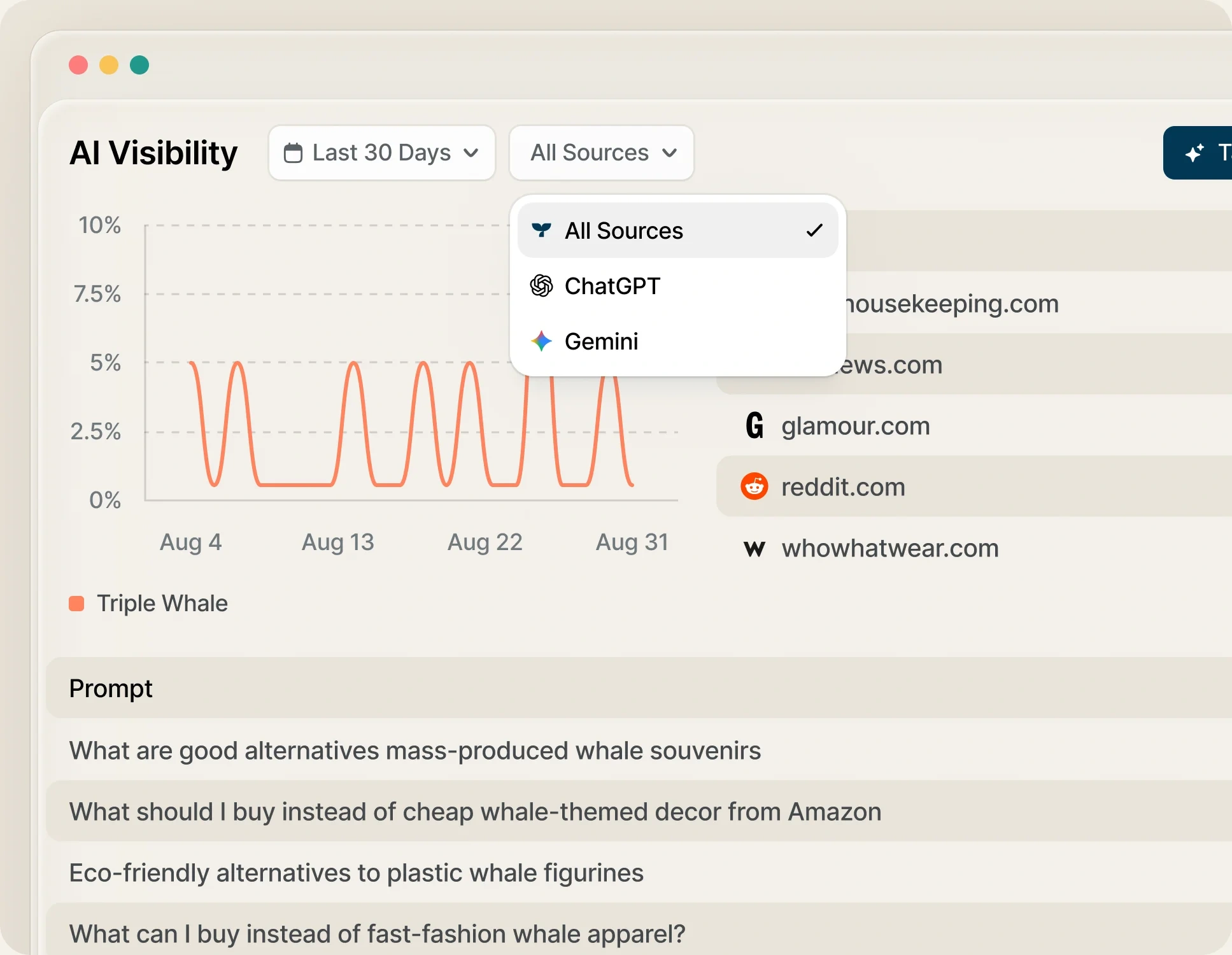
AI visibility (mentions, citations, sentiment, share of voice) across ChatGPT, Claude, Perplexity, Gemini and Google AI Overviews. The free tier covers ChatGPT visibility; the full engine set sits on paid plans. Triple Whale is also a named click-attribution and Conversions API partner for ChatGPT Ads.
Where Triple Whale is weaker
There's no modeled influence layer that puts zero-click demand into dollars; the survey tells you it exists, the pixel can't see it, and nothing bridges the two. Coverage is commerce-only, with no B2B or CRM path.
Pricing and best fit
Free tier with the Triple Pixel, basic attribution, post-purchase survey and ChatGPT visibility; paid plans above it. Best for Shopify brands that want AI orders in the report their CFO already reads. Treat the survey column as the channel's real size and the pixel column as the floor.
Founded year: 2021
Office: Columbus, Ohio, US
3. Northbeam
What Northbeam is
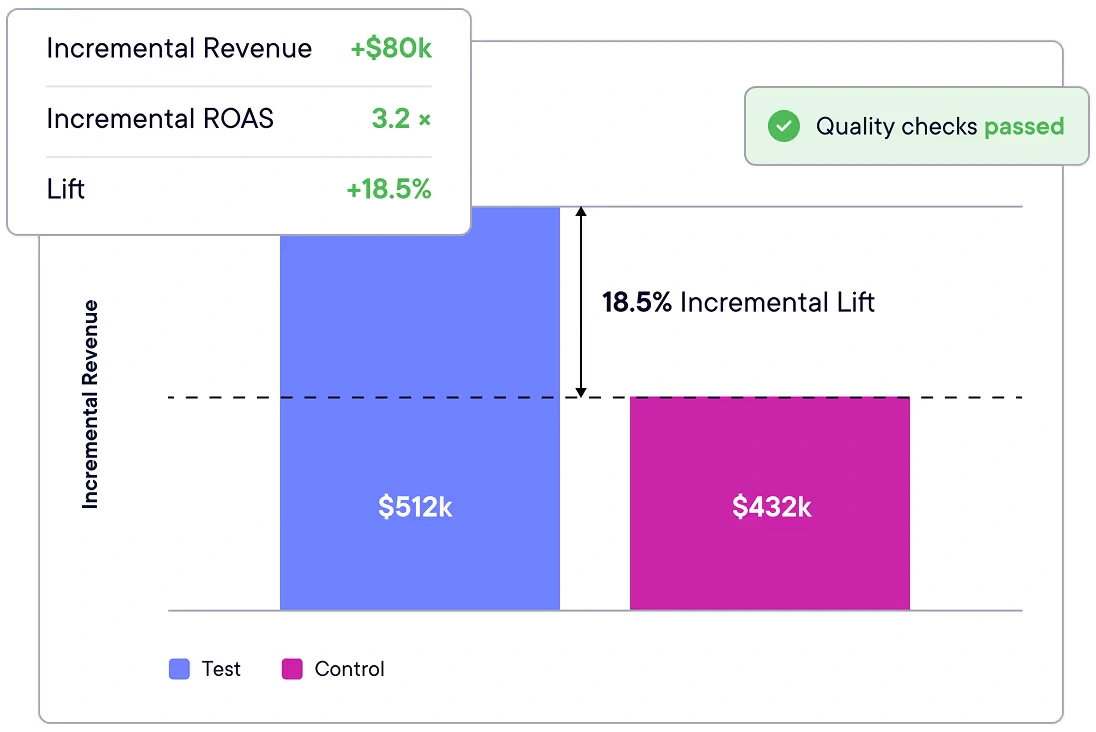
Northbeam is a marketing measurement platform for omnichannel DTC brands, founded in 2019 and backed by a $15M Series A from Silversmith Capital in August 2022. Its stack is machine-learning multi-touch attribution on a first-party pixel, MMM+ for media mix modeling, and Northbeam Incrementality (launched April 7, 2026), wired into one framework. It does not monitor AI visibility, and that's worth saying up front.
How Northbeam attributes AI search to revenue
AI referral sessions flow through the pixel like any other source and get fractional credit from the MTA model, which is explicitly designed to reduce the share of traffic other tools call Direct but isn't. For brands buying ChatGPT Ads, which moved to public self-serve in July 2026, Northbeam is a named click-attribution and Conversions API partner, so paid AI placements sit next to Meta, TikTok and CTV in the same reports.
Engines, surfaces and data covered
Whatever sends a referrer or a tracked click, plus ChatGPT Ads. No answer monitoring, no citation data, no view of Google's AI surfaces.
Where Northbeam is weaker
Observed rung only, modeled at the channel level rather than for AI specifically. Without visibility data you can't connect a lift in Direct to a change in how ChatGPT describes you. Reviewers put the practical floor near $50K a month in ad spend before the models stabilize.
Pricing and best fit
Starter from about $1,500 a month, with MMM+ on higher tiers. Best when the question is "how does AI fit into my total media measurement" rather than "how do I win AI search." Pair it with a visibility tool if you need both.
Founded year: 2019
Office: El Segundo, California, US
4. Fairing

What Fairing is
Fairing is the post-purchase survey platform behind the "How did you hear about us?" question that more than 3,000 marketers run after checkout. It does one thing: ask the customer, in the moment, what drove the purchase, and tie that answer to the order. It doesn't monitor AI answers and it doesn't model anything, which is exactly why it belongs on this list.
How Fairing attributes AI search to revenue
Fairing owns the reported rung. A buyer who answers "AI tool" gets a follow-up asking which one, and with Advanced Attribution, launched in beta on September 10, 2026 with general availability planned for January 2027, a third question asks what they typed into ChatGPT or the assistant they named. That free-text prompt is the only place a customer tells you the intent in their own words, and every response joins the order record, so AI-cited orders carry order value and lifetime value like any other source.
Fairing's own data shows how much the pixel misses. Across 158 brands in an August 2026 study, surveys surfaced 7.5x more AI-influenced orders than the strongest click-based baseline. In early Advanced Attribution rollouts, the follow-up question recovered up to 50% more usable attribution signal from the same order volume. Fairing reports in-moment response rates roughly 10x higher than delayed email or SMS surveys, with top brands completing at 45% to 85%.
Engines, surfaces and data covered
Any assistant the customer can name, plus Google AI Overviews if you add it as an option. Responses sync to 25+ destinations including Shopify, Klaviyo, GA4, Triple Whale and Rockerbox, and a Fairing MCP lets you query the data from Claude or ChatGPT. Shopify is one click; other platforms use a tracking script.
Where Fairing is weaker
A survey only reaches people who bought and chose to answer, so it says nothing about exposure that failed to convert, and recall skews toward the last memorable touch. No visibility monitoring, no modeled influence, no experiments: Fairing calibrates another tool's number rather than producing one. Advanced Attribution is still in beta.
Pricing and best fit
Free up to 200 orders a month, then volume-based; Advanced Attribution is an optional add-on. Best for any ecommerce brand that wants an independent check on its AI attribution. Pair it with Goodie or Triple Whale and compare the survey share to the modeled or pixel share every quarter.
Founded year: 2020
Office: New York, NY, US
5. Adobe Brand Visibility

What Adobe Brand Visibility is
Adobe closed its $1.9B acquisition of Semrush on April 28, 2026 and announced Adobe Brand Visibility on June 17, 2026. The product combines Adobe LLM Optimizer with Semrush's AI Optimization tool on a dataset of nearly 300 million real AI prompts, and sits inside Adobe CX Enterprise alongside Experience Manager, Adobe Analytics and Customer Journey Analytics.
How Adobe attributes AI search to revenue
The attribution angle is architectural. GEO actions connect to outcomes through Adobe Analytics and CJA, so AI search performance appears next to the revenue reporting your finance team already trusts. Adobe also owns the most-cited dataset on AI referral behavior, the Adobe Analytics panel of more than a trillion US retail visits behind the conversion figures at the top of this article.
Engines, surfaces and data covered
Prompt-level visibility across the major engines, competitive comparison, Semrush SEO data, and Adobe Analytics or CJA as the outcome layer.
Where Adobe is weaker
Everything public points to referral-based attribution inside Adobe's stack; I haven't found a disclosed method for modeling zero-click influence or a survey layer. The product launched in June 2026, and for a mid-market brand on GA4 it's the wrong size.
Pricing and best fit
Enterprise pricing through Adobe. Best for companies already on Adobe Analytics and Experience Manager that want one fewer silo. On its own, it doesn't justify becoming an Adobe customer.
Founded year: 1982
Office: San Jose, California, US
How to choose an AI search attribution tool
Start with where your revenue closes; that decides which rungs you can reach.
- Revenue closes in a CRM (B2B, SaaS, fintech). You need visibility and attribution in one system and a path to pipeline, which narrows the list to Goodie and Adobe.
- Revenue closes in a Shopify cart. Triple Whale's survey column will tell you more about AI's real size than any model; Goodie adds product-level visibility across Rufus, Sparky and ChatGPT Shopping.
- Your biggest AI line item is ChatGPT Ads. Northbeam measures it alongside everything else you buy.
- You have no AI attribution at all yet. Start with Fairing's survey; it's free at low volume and gives you the one number every other tool should be checked against.
- You already run Adobe Analytics. Test Adobe Brand Visibility before adding a vendor.
Then ask every vendor three questions. Which numbers are observed, which are modeled, and are they ever added together? How do you treat Google's AI surfaces, which send no referrer? What independent check, survey or holdout, have you run against your model? The answers tell you more than the demo.
The bottom line on AI search revenue attribution tools
The split between SEO revenue and AEO revenue in your reports is an artifact of referrer behavior, not a map of where demand starts. Pick a tool that admits that, labels what it models, and shows you the method. Then hold it to it. If your data says something different, I'd like to hear it.
Full disclosure: I’m the founder of Goodie AI. Stating the bias publicly here: it's first on this list because attribution is the problem we chose to build around. We are first to market with that product. I'll show you the method so you can judge it, and I've been as hard on us as on everyone else.
AI search revenue attribution: frequently asked questions


