
Ahrefs Brand Radar sees the widest slice of the market: about 30 million prompts built from Google search data, run through five live AI surfaces (Copilot tracking is paused for now), with the chatbot data refreshed monthly. Semrush's AI Visibility Toolkit sees a market built from AI clickstream data, and tracks 25 of your own prompts daily on its entry plan. Goodie sees the least of the market and the most of your own funnel. Pick the one whose data answers the question you're actually asking.
First, a disclosure: I founded Goodie, and it's one of the three tools here. Read it knowing that. Every claim about Ahrefs and Semrush below comes from their own pricing, help and methodology pages, dated. I've held Goodie to the same test, including where it comes up short.
The short answer: what each tool can see
All three will show you a share-of-voice chart. What matters is the data under it, and each of these tools builds that data a different way.
Prices change every few months in this category. Treat the entry-price row as a snapshot, not a ranking.
Three verdicts
Ahrefs Brand Radar: best for seeing the whole category
Pick Ahrefs Brand Radar if you need to see a whole category before you pick your own prompts. Its index is built from Google's keyword data and People Also Ask, run through the public interfaces of five live AI surfaces. Treat its impressions and share of voice as estimates weighted by search volume, and expect the chatbot data to move monthly, not daily.
Semrush AI Visibility Toolkit: best for daily tracking on a short list
Pick Semrush's AI Visibility Toolkit if your team already works in Semrush and wants daily tracking on a short prompt list. The entry plan tracks 25 prompts a day. Its market data comes from third-party clickstream. Claude isn't tracked, Perplexity only shows up in the weekly Brand Performance report, and Copilot sits in Enterprise AIO.
Goodie: best for tying AI visibility to revenue
Pick Goodie if the question is what AI visibility is doing for pipeline. It runs the prompts you choose daily, on 5 engines at Core (Gemini starts at Pro; Claude, Meta AI and the rest at Enterprise), and connects AI referrals to revenue, part measured and part modeled. Its market view is narrower: there's no browsable index of tens of millions of prompts, and Core covers 2 countries.
Why "where does the data come from" is the first question
Every one of these tools samples a system that doesn't give the same answer twice. Ask ChatGPT the same question at 9am and 9:05am and you can get a different list of brands. So two tools pointed at the same brand will return different numbers, and neither is lying. The difference is what they sampled, and what they multiplied it by.
Both incumbents say this themselves, which I respect. Semrush's documentation says "no platform can provide exact numbers on visibility." Ahrefs calls its metrics "directional indicators, not exact traffic counts."
So here's the check I run on any AI visibility dashboard, including ours. Call it the receipt test.
For every number on the screen, can the tool show you the raw answer it came from?
A mention passes. You can click through and read the response where your brand appeared. A citation passes. You can see the URL the engine linked. Share of voice weighted by search volume doesn't pass, and neither does estimated impressions, topic volume or influenced revenue. Those are models built on top of the receipts, and models are useful. You just need to know which numbers are which before you put one in a board deck.
Run the receipt test across all three tools and the real differences show up in provenance: where each one's prompts come from, and what it multiplies them by.
Ahrefs Brand Radar: what it sees, what it estimates, where it stops
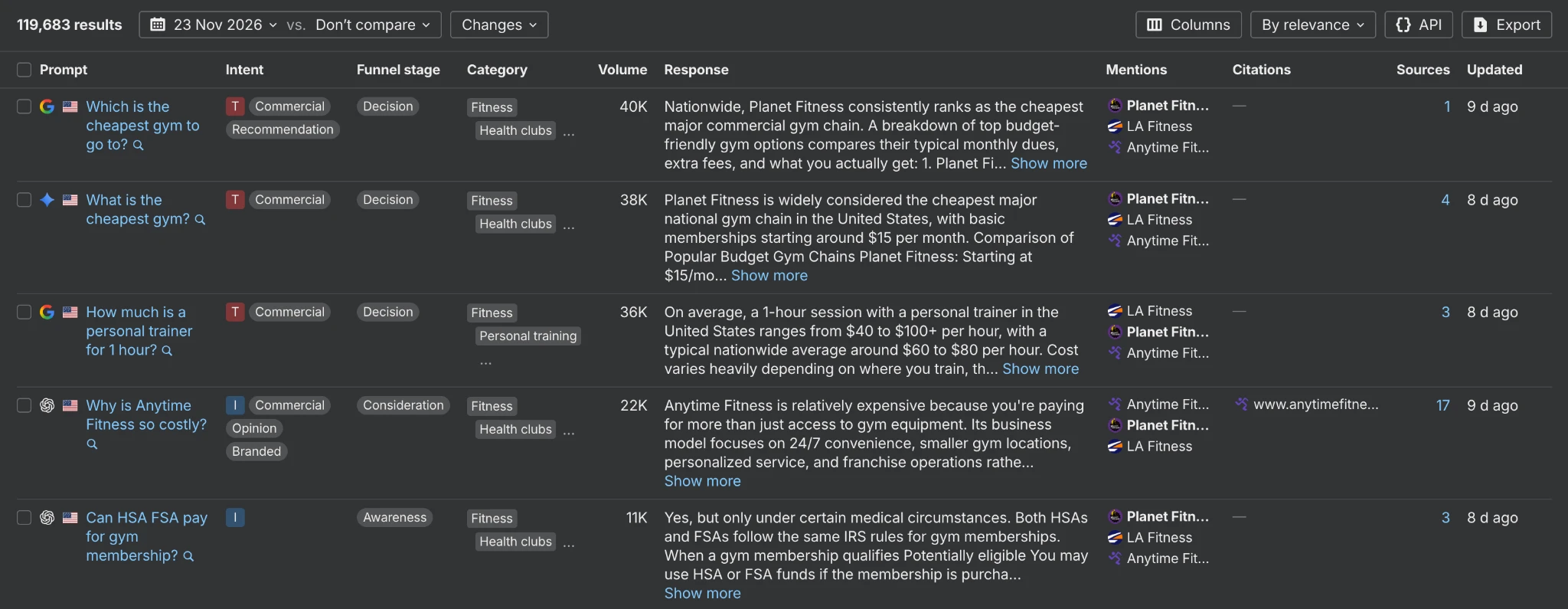
Brand Radar is Ahrefs' AI visibility product. It tracks how often AI answers mention your brand and cite your pages across AI Overviews, AI Mode, ChatGPT, Perplexity and Gemini (Copilot tracking is paused for now), using a prompt index Ahrefs builds from its own keyword data, plus any custom prompts you add.
What Ahrefs observes
Ahrefs runs its prompts through "the free, publicly available web interfaces" of ChatGPT, Gemini, Perplexity and Copilot, and stores the raw responses (Ahrefs methodology). AI Overviews and AI Mode come from Google results. A mention is a string match in a stored response. A citation is a linked URL. Both pass the receipt test.
Ahrefs added entity matching in August and sentiment in October (Ahrefs changelog), which cuts down false positives for brands with common names.
What Ahrefs estimates
The prompts themselves. Ahrefs builds them from Google's People Also Ask data and its keyword database, then expands them with a semantic fan-out. Ahrefs describes this as modeling "real-world user behavior, rather than fabricating prompts." That's fair. It's still Google demand standing in for chatbot demand, and those two don't always line up.
Then the weighting. Estimated Impressions weight your mentions by the Google search volume behind each prompt. Ahrefs is candid here: it calls this "a modeling choice, not a measured relationship." Since July, reports use AI-adjusted volume, which multiplies the parent keyword's Google volume by Ahrefs' estimate of each platform's usage. Say a prompt's parent keyword gets 10,000 Google searches a month and a platform's usage ratio is estimated at 5%. That prompt counts as 500 on that platform. Useful for sizing, but not a count of anyone asking anything.
Where Ahrefs' coverage stops
Engines: five live in the index. Copilot is still listed, but Ahrefs' own app says Copilot tracking is paused after Microsoft changed its access requirements, so no new Copilot answers are coming in. Claude is available on custom prompts only, at 8 checks per update because of cost. Grok was added in April, but Ahrefs' help center currently says it "cannot collect any new data for the time being." No shopping assistants.
Regions: locations mirror Ahrefs' keyword data, and coverage is strongest in English. Ahrefs doesn't publish a country list.
Refresh: the ChatGPT, Perplexity and Gemini index refreshes monthly on a 90-day window. AI Overviews and AI Mode update continuously. Custom prompts can run daily.
Prompt sources: Google demand only. Ahrefs says itself that brands and questions with little search volume are underrepresented. If your buyers ask long, specific questions that nobody types into Google, the index won't have them. Your custom prompts will.
Profound is the other name buyers usually weigh against Brand Radar. I've covered it in my Profound alternatives guide.
Semrush AI Visibility Toolkit: what it sees, what it estimates, where it stops
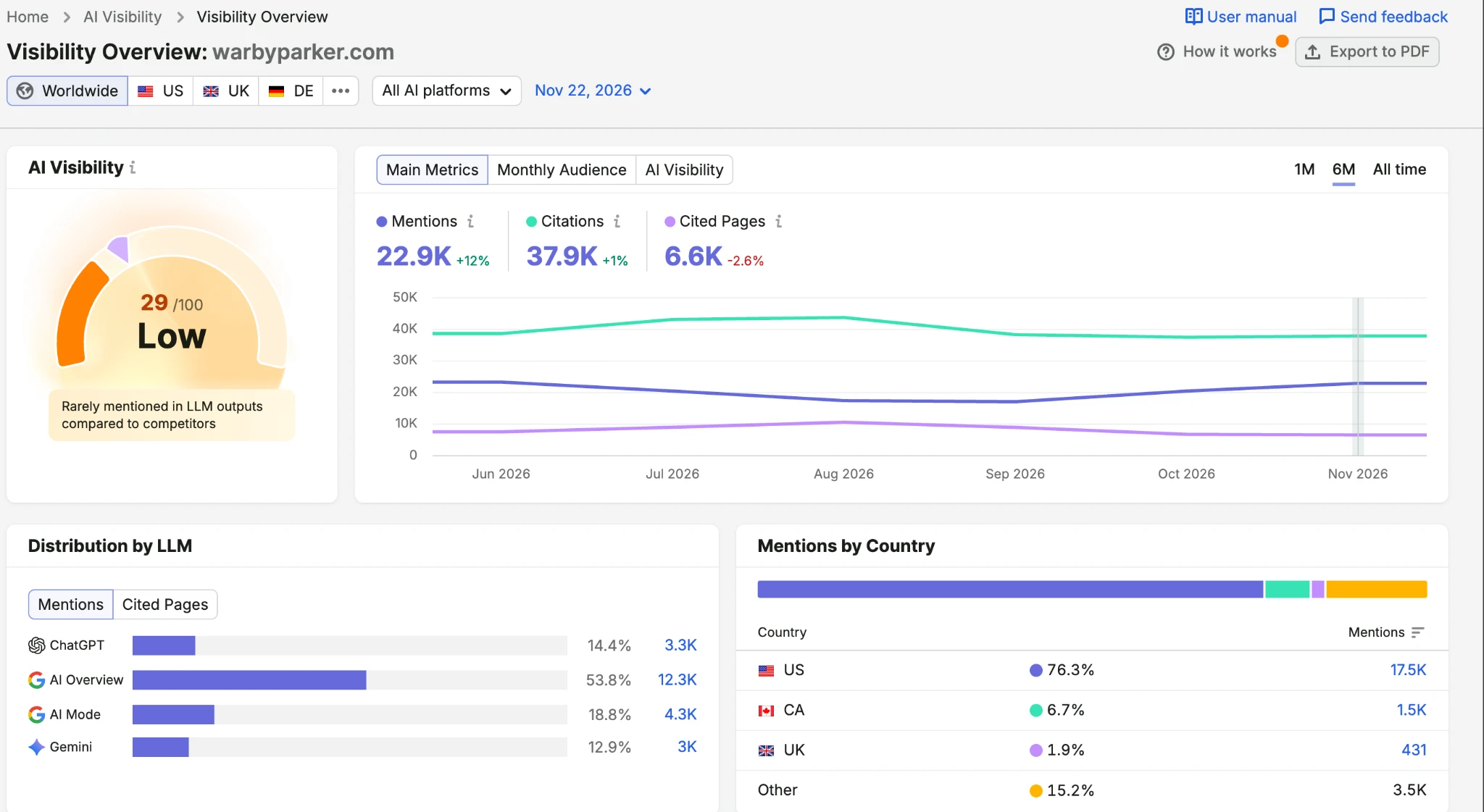
Semrush's AI Visibility Toolkit is its AI search tracking product. It reports brand mentions, citations and share of voice across ChatGPT, Google's AI surfaces, Gemini and Perplexity, from a prompt database Semrush builds from clickstream data, plus daily tracking of your own prompts.
There are three ways to buy it: the standalone toolkit, the SEO + AI Search plans (Starter includes 50 prompts, Pro+ 100), and Enterprise AIO on custom pricing. Semrush is now an Adobe company. Adobe completed the acquisition in May.
What Semrush observes
Semrush says its responses are "captured from real requests and not via any APIs of LLMs," and that ChatGPT runs "in search mode" (Semrush KB). Prompt Tracking queries your prompts daily on AI Mode, AI Overviews, Gemini and ChatGPT. Its AI Search Site Audit checks whether eight AI crawlers can reach your site. That's access, not visits, but it's real.
What Semrush estimates
The prompts. Semrush sources "billions of real prompts from AI search clickstream data and Google's keyword dataset," then groups them into topics, removes duplicates and simplifies the phrasing. So the prompt you see in the report is a representative rewrite, not what a person typed.
The volume. Topic volume combines third-party data on real AI interactions with Semrush's own machine learning models. The AI Visibility Score (0 to 100) is a composite of topic coverage and mention consistency. All three are models.
Clickstream is a real advantage over pure keyword data. It's closer to how people actually talk to a chatbot. It's also a panel. You're seeing what a sample of users did, scaled up.
Where Semrush's coverage stops
Engines: Claude isn't tracked as an answer engine. Semrush's Site Audit only checks whether Claude's crawlers can get in. Perplexity appears in the weekly Brand Performance report, not in daily Prompt Tracking. Copilot is Enterprise AIO only. No Grok, Meta AI or shopping assistants on any published tier.
Regions: Semrush lists 117 regional databases for its market data, and Prompt Tracking runs in 220+ countries. This is where Semrush is clearly ahead of the other two.
Refresh: market data updates daily on a rolling basis, Brand Performance weekly, Prompt Tracking daily.
Goodie: what it sees, what it estimates, where it stops
Goodie is an answer engine optimization platform. It tracks how AI answers mention and cite your brand on prompts you define, then connects that visibility to your own traffic and revenue data. This is my company, so I'll be as specific about its gaps as I was about the others'.
What Goodie observes
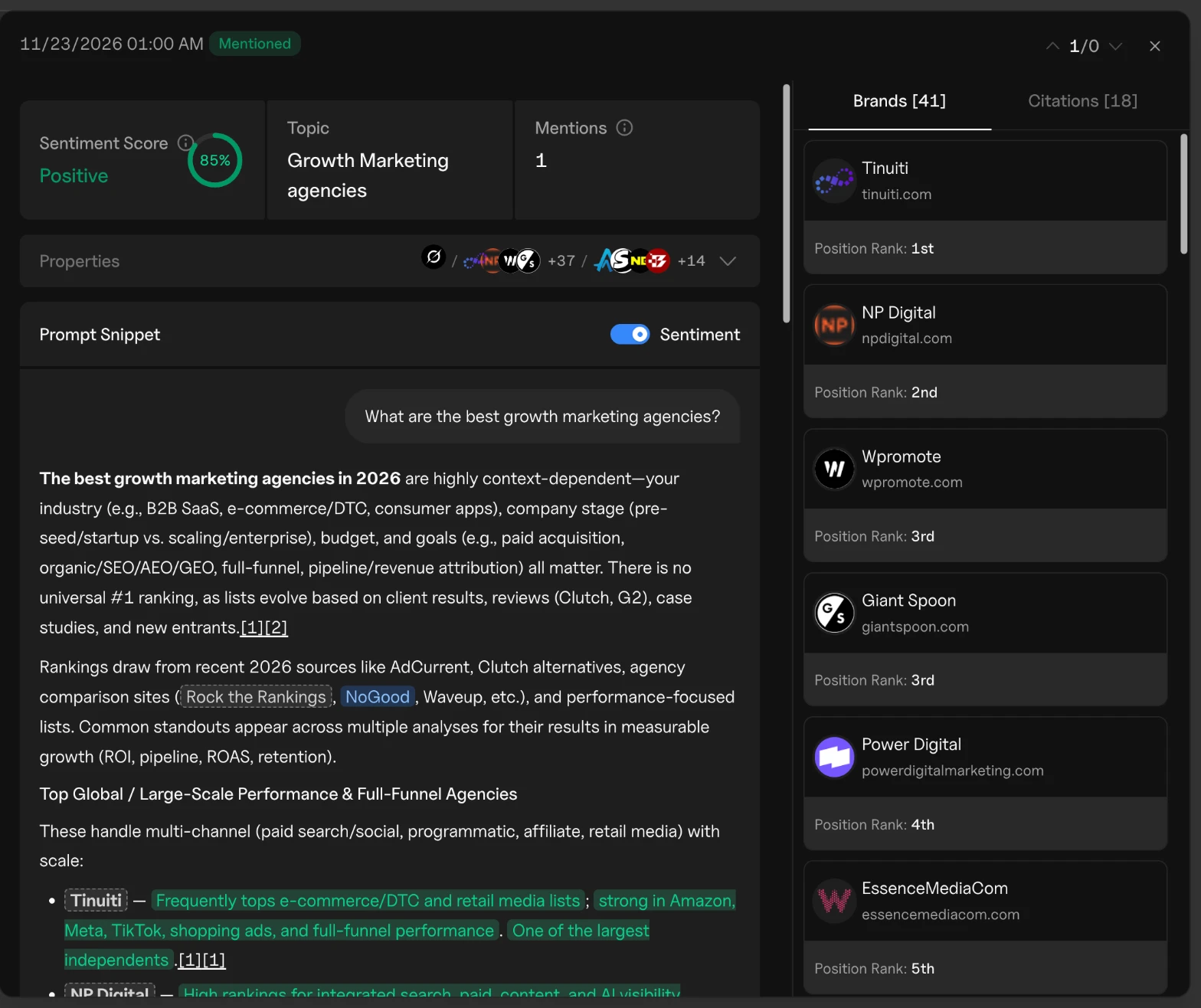
Daily runs of the prompts you define, on every engine in your plan. Goodie's tracking "focuses on publicly accessible" interfaces, per its ChatGPT page. Each run is stored as a Prompt Result for one prompt, on one model, in one country and language, so the mention and the citation are both there to open.
On your own site, Goodie reads AI crawler and agent visits from your CDN or hosting logs (Cloudflare, Vercel, WordPress, CloudFront, Akamai). And it reads AI referral sessions and conversions from GA4. Those are your numbers, not a panel's.
What Goodie estimates
Revenue attribution is part measured, part modeled. Direct AI referrals in GA4 are measured. The uplift in branded search and direct visits that AI answers drive is modeled, because a lot of AI influence shows up with no referrer at all. Prompt research volume is an estimate too.
So Goodie fails the receipt test on influenced revenue, same as Ahrefs does on impressions. The difference is that the measured half sits on your own analytics.
Where Goodie's coverage stops
Market view: there's no browsable index of tens of millions of prompts. Goodie tracks the prompts you choose. If you don't know which questions matter yet, Ahrefs or Semrush will show you more of the market faster.
Engines and regions are capped by plan. Core covers 5 engines in 2 countries and 2 languages. Gemini starts at Pro. Claude, Meta AI, Grok, DeepSeek and Muse are Enterprise only. Prompt volume is capped too: 110 on Core, 250 on Pro.
Method: Goodie publishes less about its collection method than Ahrefs does. "Publicly accessible interfaces" is the extent of it on the site. If I'm asking that question of Ahrefs and Semrush, you should ask it of us.
If you want Goodie weighed against other dedicated platforms rather than the suites, I've done that in Goodie AI vs Writesonic vs AthenaHQ.
Where coverage stops: the engine map
Semrush Enterprise AIO adds Copilot. Its full engine list isn't published. "Not listed" means the vendor's own pages don't name the engine. It doesn't rule out a custom arrangement.
The price per tracked prompt, and why you have to compare per engine
Everyone compares these tools on sticker price. That's the wrong unit, because each vendor charges for something different. Ahrefs charges per check: one prompt, on one engine, in one location. Semrush charges per prompt. Goodie charges per prompt across every engine on your plan.
So convert everything to one unit: the cost of tracking one prompt on one engine, daily, for a month.
Here's the math.
Semrush: $99 buys 25 prompts. If each prompt runs on all four tracking engines, that's 100 prompt-engine pairs, about $0.99 each. If it runs on one, it's $3.96. Semrush's pages don't say which.
Ahrefs: daily tracking is about 30 checks a month per prompt-engine pair. The $50 Basic pack gives 2,500 checks, which covers about 83 pairs. That's about $0.60 each. Track Claude and every update costs 8 checks instead of 1. If your account also needs a base plan, Lite starts at $129 a month and includes 150 checks of its own.
Goodie: Core is $295 a month billed annually for 110 prompts on 5 engines. That's 550 pairs, about $0.54 each, assuming every prompt runs on every engine daily.
On these numbers, the extra money mostly buys coverage (more engines, more countries, shopping assistants) and what happens after the number (actions, attribution), rather than cheaper prompts. Run this math again the week you buy. These prices will have moved.
Already pay for Ahrefs or Semrush? What to add, if anything
Here's the part a vendor CEO isn't supposed to write.
If you already pay for Ahrefs, you already own some AI search tracking. Lite includes 150 checks a month: five prompts on one engine, daily. Standard doubles that, Advanced doubles it again. If you're tracking a handful of prompts on the open web and nothing you sell sits on a retail shelf, you don't have a tooling problem. You have a quota you haven't turned on. Go use it, and buy nothing yet.
You'll know when you've outgrown it. You'll be picking which prompts to stop tracking.
From there:
- You live in Semrush and need daily numbers on 25 to 100 prompts: the toolkit or an SEO + AI Search plan.
- You need to size a category, or find prompts you didn't know to track: Ahrefs' index.
- You sell on Amazon or Walmart, need Claude or Meta AI, or have to show revenue impact to leadership: a dedicated platform. Goodie is one. My buyer's guide covers the rest, and the wider field of GEO platforms goes further.
Plenty of teams end up running both: a suite for market discovery, a dedicated tool for tracking and attribution. Those two jobs need different data, so I don't think that's redundant.
Five questions to ask any AI visibility vendor about its data
- Where do your prompts come from: search data, a clickstream panel, or the prompts I give you?
- Do you capture answers through the consumer interface or an API, logged in or out, with web search on?
- Which numbers on this dashboard are observed, and which are modeled?
- How often is each engine re-run, and in which countries?
- On the plan I'm buying, how many prompts, on how many engines, and what's the overage?
If a vendor can't answer the third one in a sentence, the dashboard is mostly models. (Including mine.) For cheaper dedicated options that answer these differently, see Goodie AI vs Otterly vs Scrunch.
Ahrefs and Semrush did something I didn't expect when I started this comparison: they published most of their own limits. That's the bar now. Pick the tool whose receipts match the decision you need to make, and ask every vendor, including me, to show you theirs.
Ahrefs Brand Radar vs Semrush AI Toolkit vs Goodie: FAQs



