
The short answer: AEO for B2B SaaS means getting your product into the answers AI models give every person on the buying committee, including the ones who never type the first search. Forrester puts the typical B2B purchase at 13 internal stakeholders, and 94% of buyers use AI somewhere in the process. The champion, the CFO and the security reviewer each ask a different question, and the model grounds each answer in different sources. You need to be in all of them.
I see this from both sides. Goodie, the AEO platform I run, gets bought by committees like the ones in this piece. NoGood, my agency, works with B2B SaaS teams trying to get on those shortlists. Some of the citation data below comes from Goodie's published studies, and every figure links to its method.
Your Buyer Is 13 Stakeholders and 9 Outside Influencers
That's Forrester's number for the typical B2B purchase in 2026: 13 internal stakeholders, plus nine people outside the company with a say. When the product has generative AI features, the group doubles, from seven to 14.
And 94% of buyers are asking an AI model somewhere along the way.

Almost every AEO playbook I read is written for one of those people. It’s usually the champion, the one typing “best CRM for a 50-person sales team.” That’s the right person to start with, but it’s also the wrong place to stop. It's still important to cover all bases: the CFO is asking what it costs at 200 seats, security is asking whether you support SSO, and the end user is asking Reddit whether it's any good.
They all get an answer. The question is how many of those answers have your name in them.
What Does AEO for B2B SaaS Mean?
AEO for B2B SaaS is the work of making your product show up, accurately and favorably, when AI models like ChatGPT, Perplexity, Gemini and Google's AI Overviews answer questions from software buyers. In B2B, that means answering for a buying committee: the group of people who research, evaluate, approve and sign off on a purchase.
A committee usually includes a champion who wants the tool, an economic buyer who owns the budget, a security or IT reviewer who can veto it, procurement, and the people who'll use it every day.
(Quick note: GEO, generative engine optimization, describes the same work. I use AEO here.)
Why B2B SaaS AEO Is Different
Three things separate it from consumer AEO.
More than one person has to find you. In eCommerce, one shopper asks one question and the model also acts as the storefront. In B2B SaaS, five or six people ask five or six questions, and the deal needs most of them to come back with your name.
The shortlist forms before you know there's a deal. Buyers do most of their research alone, with AI, and talk to sellers late.
Every answer gets checked. A consumer might buy the first thing the model recommends. A committee verifies it against reviews, peers and analysts before anyone signs.
Each of those changes what you publish, where you earn coverage and how you measure.
How Buying Committees Use AI
Mostly in the middle of the journey. 6sense's 2025 buyer research found 94% of buyers use AI models during a purchase, mainly to compare vendor offerings, evaluate proposals, analyze stakeholder input and create shortlists.
That middle is exactly where the shortlist gets built. Buyers evaluate 5.1 vendors on average, and 3.6 of them are already on the shortlist on day one. First contact with a seller comes 61% of the way through the journey. And 77% of the time, buyers contact the vendor they end up choosing first.
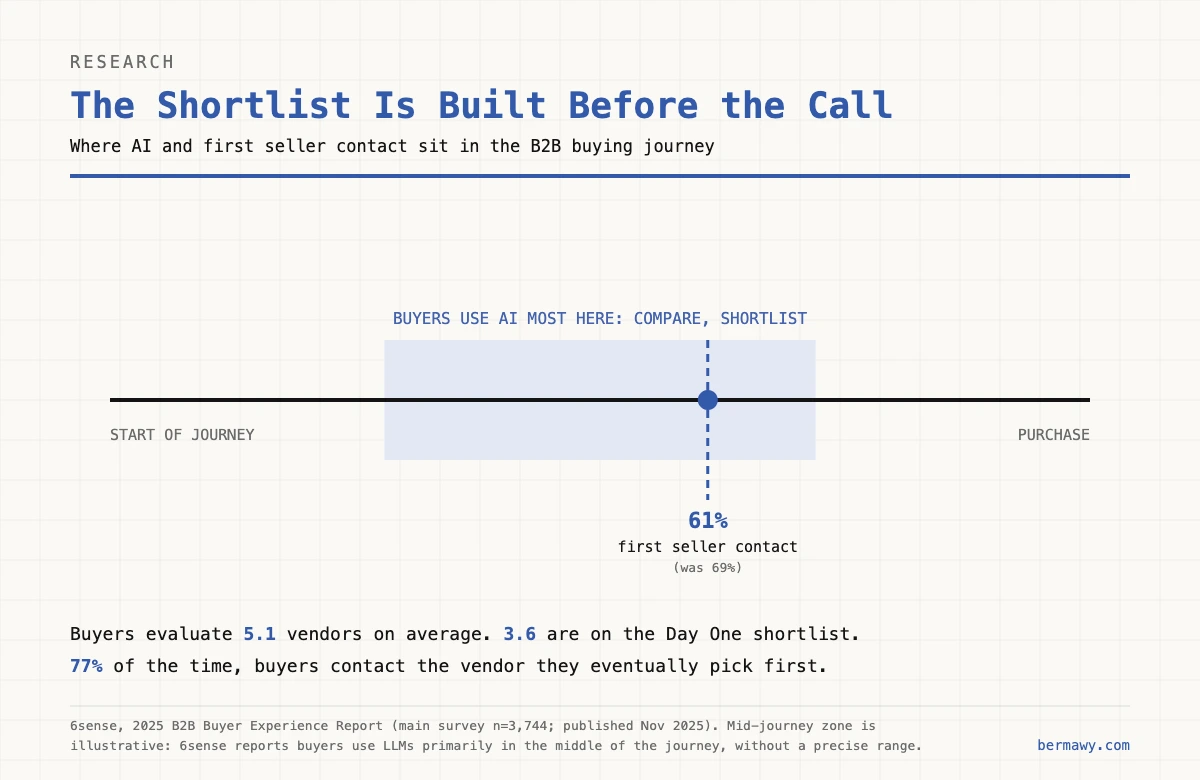
So for B2B SaaS, the model is where the shortlist gets written. If you're not in the answer before the first call, there's usually no first call.
The model also moves deals. In G2's April 2026 survey, 69% of software buyers said they chose a different vendor than they'd planned because it showed up in a chatbot's recommendation. In its July survey, 82% said they'd sourced software recommendations from an AI chatbot in the past two years.
None of this is a new idea in B2B. Sales teams have mapped stakeholders for decades. What changed is that every one of those stakeholders now has a research assistant that answers in full sentences, and some of them are starting to hand the research to agents. G2 found 47% of buyers would let an AI agent research and recommend vendors. Only 9% would let one buy. I wrote about what that shift means for marketers.
The Committee Answer Map
Keyword strategy taught us to compete query by query. Committee buying means competing seat by seat. "Best product analytics tool" and "product analytics tools with SOC 2 and SSO" are different contests with different winners, and losing the second can knock you out of the first.
Here's the map I'd build for any B2B SaaS category. Each seat, the question it asks, where the model gets the answer, what you publish, and the proof the model needs to trust you.
| Seat | What they ask the model | Where the answer comes from | What to publish | Proof the model needs |
|---|---|---|---|---|
| Champion | "Best [category] for [use case]" | Publishers, listicles, Reddit | Use-case pages, honest comparison pages | Third-party roundups and community threads that name you |
| Economic buyer | "What does [category] cost at 200 seats?" "ROI of [category]?" | Pricing pages, cost breakdowns, publishers | Pricing logic, what drives cost, what a typical team pays | A pricing page with real numbers or ranges, in HTML |
| IT / security | "Does [vendor] support SSO, SOC 2, EU data residency?" | Review platforms like Gartner Peer Insights, trust centers, docs | A crawlable trust center and integration docs | Certifications, SSO/SCIM, subprocessors and residency stated in plain text |
| Procurement | "Alternatives to [vendor]?" "Contract terms?" | Review platforms, analyst content, comparison pages | Alternatives pages, clear terms, migration docs | Comparisons that include you, with facts the model can verify |
| End user | "Is [vendor] easy to use?" "[A] vs [B] for my workflow?" | G2, Reddit, YouTube, LinkedIn | Tutorials, docs, practitioner content | Recent user reviews and practitioners talking about you |
The prompts in the map are illustrative. The sources aren't. They come from Goodie's citation research.
In our study of roughly 118,000 citations from B2B SaaS prompts (February to June 2025), more than 35% came from just 10 sources. Not one SaaS company's own website made the top 10. Reddit led on ChatGPT and Perplexity. On Claude, Capterra knocked it off the top spot, and on Gemini, Reddit fell to sixth. LinkedIn only showed up in Perplexity’s top 10.
The security seat looks different again. In Goodie's October 2026 reviews study, Gartner Peer Insights is the most-cited review source in cybersecurity and in data and analytics. In enterprise operations software, it's G2. In CRM, it's TechRadar, ahead of G2 and Capterra combined.
Same company, same product, different seat, different source. If you've only worked on the sources behind the champion's question, you're invisible to everyone the champion has to convince.
My bet is that this also changes the shortlist itself: that the CFO and the champion walk into the same meeting having been shown different vendors. That's the next thing I want to measure.
What to Publish for Each Seat
For the Champion
The champion asks the broad question, so the answer is built from roundups, comparisons and community threads. Publish use-case pages that name the job, the team size and the alternative you replace. Publish comparison pages that include competitors fairly, with a table a model can lift one row from. Structure matters here more than length. Then earn your way into the third-party roundups the model already trusts, because your own page won't be the source.
For the Economic Buyer
G2 found finance involvement in software decisions rose from 31% to 46% in one year. The CFO's question is about cost, predictability and ROI, and the model answers it with whatever pricing information it can find.
If your pricing page says "contact sales," the model fills the gap from third-party estimates, old listicles and competitors' comparison pages. Publish the logic: what drives cost, what a typical team pays, what's included and what isn't. You don't need every number public. You need to stop someone else from publishing them for you.
For IT and Security
Forrester found procurement is a decision-maker in 53% of buying cycles. Security sits right beside it, and either one can end a deal with a single answer.
Make your trust center crawlable: certifications, SSO and SCIM support, data residency, subprocessors and incident process, in plain HTML, not a gated PDF. Keep integration docs public. And if you sell into security or data teams, take Gartner Peer Insights as seriously as G2, because that's where the model looks in those categories. I've covered how enterprise teams evaluate AI search platforms on security and integration in more depth.
For Procurement
Procurement asks for alternatives, terms and risk. If you don't publish an honest alternatives page, your competitor's "alternatives to you" page answers the question instead. Publish clear terms where you can, migration and offboarding docs, and plain facts about the company: how long you've operated, who you serve, how support works. Don't make claims the model can't verify. It will either skip them or find the page that contradicts them.
For the End User
End users ask whether the tool is any good to use, and the model asks their peers. That means reviews, Reddit threads, YouTube walkthroughs and practitioner posts. Keep tutorials and docs public and current. Ask happy customers for reviews on the platforms your category's answers cite. And put practitioners on LinkedIn: Goodie's research found LinkedIn Articles earn nearly six times the AI citations of feed posts.
Third-Party Authority: Where the Answer Actually Comes From
Your website is where the model checks facts, prices and features. It's rarely where the recommendation comes from. In B2B SaaS, that job belongs to publishers, review platforms, comparison content, documentation and communities. My team and I make the same point in NoGood's AEO guide: earned coverage does most of the citation work.
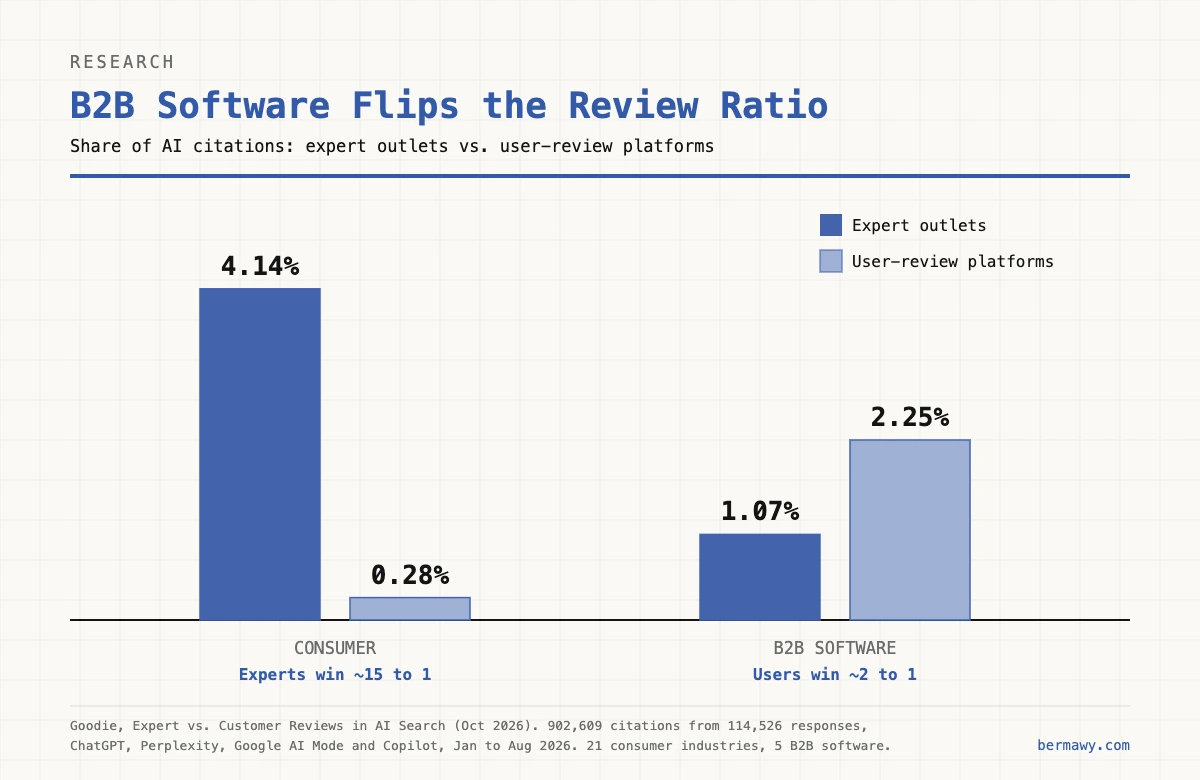
Here's the part that surprised me. In consumer categories, AI models trust experts. Across 21 consumer industries in Goodie's latest study, expert outlets out-cited user reviews about 15 to 1.
B2B software flips it. User reviews take 2.25% of citations. Expert outlets take 1.07%. User reviews lead in three of the five software categories we measured.
And buyers are checking. In G2's April 2026 survey, AI chatbots were the top source shaping software shortlists. By G2's July survey, review sites had edged ahead, 38% to 37%. Those are two different surveys, so I wouldn't call it a trend. But it fits what Forrester heard: buyers say AI answers can be incomplete or unreliable, so they verify with peers, experts and analysts.
The committee checks the model's work. The model checks your users' reviews. So the people who verify your product for the committee are mostly your own customers, and your customer marketing team is doing AEO whether anyone calls it that or not.
Four sources do most of the work, and you can influence all of them:
- Reviews. G2, Gartner Peer Insights and Capterra, weighted by which one your category's answers cite.
- Comparisons. Third-party roundups and your own honest comparison pages.
- Documentation. Public docs, trust center, pricing logic. The model uses these to confirm what others say about you.
- Community. Reddit, LinkedIn, YouTube. Reddit's role is big enough that I wrote a separate guide on it.
Brand ties all four together. The more people already know and talk about you, the more often every source mentions you.
How to Measure Committee-Wide AI Visibility
One share-of-voice number hides the problem. You can be strong for the champion and missing for finance, and a blended score will average that into "fine."
I measure it as seat coverage: your visibility measured separately for each seat on the committee. This is a framework I recommend. We haven't published per-seat results yet. Here's the setup:
- Write a prompt set per seat. Four to six prompts each for the champion, economic buyer, security, procurement and end user, in your category. Use the questions they actually ask, in their words.
- Track them separately. If your AI visibility tool can group prompts by persona or tag, use that. If it can't, a consistent prompt list and a spreadsheet will do. If you're choosing a tool, I compared the main ones.
- Report per seat. Visibility, share of voice and position, by seat and by model.
- Track sources per seat, as well as mentions. The useful question is which domains the model cited when it answered each seat. That tells you where to work.
- Watch the gap between seats. Your weakest seat is the one that stalls deals. Fix that one first.
Two cautions. AI answers vary from run to run, so read trends over several weeks. And don't present early numbers as proof of anything until the pattern holds. For the wider measurement setup, start here.
Your First 30 Days
Week 1: Build the map.
- List the seats on your typical deal. Ask sales who joins late and who kills deals.
- Write four to six questions per seat in your category.
- Fill in the Committee Answer Map: where each answer comes from today, and what proof is missing.
Week 2: Baseline.
- Run every seat's prompts across ChatGPT, Perplexity, Gemini and Google's AI results. Repeat a few times.
- Record per seat: are you mentioned, in what position, and which sources were cited.
- Pick your two weakest seats.
Week 3: Fix your own pages for the weakest seats.
- Publish pricing logic for the economic buyer.
- Make the trust center and integration docs crawlable for security.
- Ship or update one honest comparison or alternatives page.
Week 4: Start the third-party work, and set the rhythm.
- Launch a review push on the platforms your category's answers cite.
- Pitch two or three publishers and roundups that already appear for the champion's questions.
- Set up monthly per-seat reporting, and name one owner for the map.
Thirty days won't move every seat. It will show you which one is costing you deals, and that's worth more than a blended score that looks fine.
Who Owns This Inside a SaaS Company
Every seat already has an owner. Product marketing owns comparison pages. Content owns use-case pages. Security owns the trust center. RevOps owns the CRM data that tells you which seat stalls deals. Customer marketing owns reviews.
Nobody owns the map across them.
On the B2B SaaS teams we work with at NoGood, the seat map usually exists. It's just split across five people who never compare notes. PMM owns the comparison pages, security owns the trust center, and nobody owns the question of whether the model shows any of it to the right person.
Someone has to. In most companies I'd put it with product marketing, because PMM already thinks in personas and competitive positioning. The job is small to describe: keep the map, run the per-seat measurement, and route the gaps to whoever owns the fix.
What I'd Stop Doing
I'd stop reporting one share-of-voice number for a product that six people have to approve.
A blended score tells you you're visible. It doesn't tell you to whom. You can be on the champion's shortlist and missing from the CFO's, and the dashboard will look fine right up until the deal stalls in finance.
I'd stop treating reviews as a sales-enablement afterthought. In B2B software, they're the source the model trusts most.
And I'd stop hiding pricing and security details behind forms. Every gated answer is an answer the model writes from someone else's page.
Map the seats. Measure each one. Then go fix the one you're losing.
AEO for B2B SaaS: FAQs


