
If you scroll LinkedIn or X this week, you'd think Google just buried an entire emerging discipline in a single doc.
Google published a new guidelines documentation titled "Optimizing your website for generative AI features on Google Search." In it, the company defined AEO and GEO, then declared that from Google Search's perspective, optimizing for generative AI search is optimizing for the search experience, and thus still SEO.
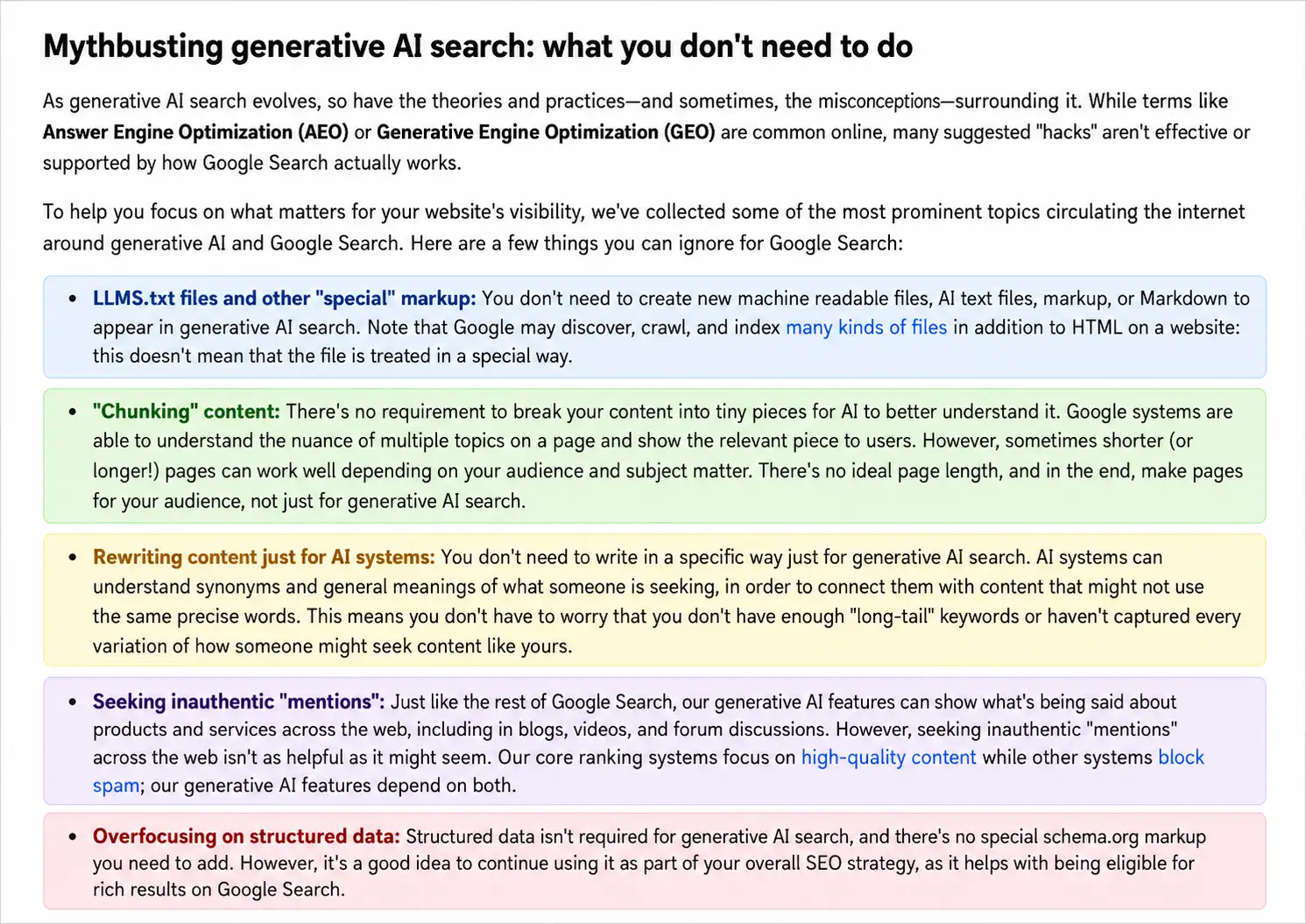
It went further and labeled tactics like llms.txt files, chunking, and inauthentic mentions as unnecessary, listing them in a dedicated "Mythbusting generative AI search" section.
The SEO industry took a victory lap. Half of LinkedIn declared AEO was always vaporware. The chorus was loud.
Read the actual guidance carefully though, and a few questions start to nag.
If AEO isn't real, why did every legacy SEO platform race to ship an AEO module?
SEMrush, Ahrefs, and Conductor all pivoted. Why does every MarTech company, HubSpot, Webflow, Adobe, treat this category as an existential risk?
Why has HubSpot already acquired xFunnel to bolt AEO into its stack? And Adobe dropping 2 Billion on SEMrush?
Why has more than $300 million in venture money landed in pure-play AEO startups in under twelve months including Profound, AirOps, Bluefish, Peec, Scrunch and many others?
Why did Microsoft, three days into 2026, publish its own playbook treating AEO and GEO as distinct, formal disciplines retailers must build for?
Markets aren't always right.
But Sequoia, Kleiner Perkins, NEA, Felicis, and Lightspeed all converged on the same category in the same eighteen months, something is clearly happening.
Read What Google Actually Said
The clickbait read of Google's guide is "AEO is dead." The careful read is closer to: "AEO, as some consultants are selling it, doesn't move the needle inside Google's surfaces. Here's what does."
Google was specific about what it dismissed. Site owners don't need to create llms.txt files or special AI schema. "Chunking" content for retrieval isn't required. Inauthentic mentions don't help. Fair points. A lot of that advice was always thin and incentive-driven.
Google was equally specific about what's real. Its AI features are rooted in the same core Search ranking and quality systems, and they rely on retrieval-augmented generation and query fan-out to pull from the Search index. That's the company conceding, in plain language, that the retrieval mechanics have shifted. RAG and query fan-out are not how Google's blue-link algorithm worked in 2015. They are AI-native retrieval patterns. Calling all of it "still SEO" is a branding choice, not a technical one.
Here's the part the victory lap ignored: this guidance is about Google Search. It doesn't speak for ChatGPT, Claude, Perplexity, Grok, Alexa for Shopping, Copilot, or the agentic commerce layer most of these companies are racing to build. Those systems retrieve, weight, and cite differently.
Microsoft's January 2026 playbook is the cleanest counter-evidence. Microsoft treats AEO and GEO as two distinct disciplines that determine whether content gets surfaced inside AI experiences. It even reframes AEO as "Agentic Engine Optimization" to account for the rise of browser agents and shopping agents. Acronyms aside, the framework draws a real line: AEO is about clarity through agent-accessible, real-time data across owned, earned, and social content. That's not "still SEO." That's a deliberate division of labor across surfaces. Microsoft owns Copilot and Bing and holds roughly 27% of OpenAI on an as-converted basis. They've earned the right to have a view.
We'll hear from OpenAI and Anthropic on this soon enough. When we do, expect their framing to be just as conservative, and just as shaped by their own interests and risks as fast-growing platforms with a lot to protect.
Google Was Anti-SEO Once Too
I have been in the SEO space since 2009. I joined mid Matt Cutts era and have read every meaningful thing Google has published about search since. From Cutts as the singular voice every SEO hung on, to the in-between years when John Mueller and Gary Illyes split the public-facing load, to the Danny Sullivan Search Liaison era when SEOs and Google became something close to besties, all the way to today's post-Sullivan Search Central era.
The thing the current SEO chorus is missing is that Google has clear interest in this conversation, and the most to lose. Another discipline means another tech stack to compete with, another emerging ad surface, and more media dollars leaving Search for channels Google doesn't own. I have a ton of respect for Google. I also know they have always played a conservative, understandably biased hand on this.
Not to bore you with a history lesson, but I'm going to do it anyway.
In its earliest days, Google was openly hostile to the practice of optimization. The founders saw it as manipulation of an information system. To be fair, there was a lot of black hat stuff back then that deserved to be penalized. The Florida update in 2003 wiped out sites built on keyword stuffing. The link-farm crackdowns devalued entire agency networks overnight. When the SEO firm SearchKing sued Google that same year for tortious interference after its clients' PageRanks were tanked, Google argued that its rankings were opinions protected by the First Amendment. The court agreed. The precedent stuck. For years after, Google's own guidance warned webmasters against hiring SEO agencies at all.
It took the entire Matt Cutts era for Google to publicly accept that SEO was a legitimate marketing discipline rather than a manipulation tax. The Sullivan years cooled the relationship into something functional and genuinely cooperative but that moment was forged in courtrooms, Twitter fights, penalty updates, and public spats.
Read Google's new AI guide with that history in mind, and with the bias at play, and it lands differently. It is a company telling the market what it wants the market to do. That is reasonable. It is not the same thing as the truth about how every AI surface retrieves information.
I guarantee you the next era won't be any easier than the last one.
The Technical Shift Shouldn’t be Ignored
The thing that frustrates me about the "AEO is just SEO" framing is that it papers over real engineering differences across platforms and holds us back from rethinking the playbook.
Google's AI features run on RAG against Google's index, with query fan-out generating concurrent related queries. ChatGPT uses different retrieval, with deeper conversation context and a much heavier reliance on training data and partner integrations.
Perplexity is closer to a real-time search-first system. Claude leans on synthesis and structured reasoning over verbatim retrieval. Grok is structurally coupled to X data.
Amazon's Alexa for Shopping — the assistant that absorbed Rufus when Amazon retired it as a standalone product in May 2026 — is shopping-graph-first, as is Walmart's Sparky. Each of these surfaces has its own ranking signals, its own preferred source types, and its own degree of platform coupling.
AEO is not only about how a page is written or indexed. It is everything that happens after.
To AI models, a brand is not who it claims to be on its own site. A brand is everything else the model is trained on and cites. It is unfair to ask SEO teams why a brand does not show up for a high-intent prompt when YouTube, Reddit, reviews, and third-party sites are influencing most of the answer. SEO, social, and PR usually live on three separate islands. None of them owns the full picture today.
We ran the largest study of social citations across ten LLMs to date and the data was striking. X citations are almost exclusively a Grok behavior, at 99.7%. Instagram citations are almost entirely AI Overviews. YouTube citations are 82.5% Google surfaces. That's clear structural coupling between models and the platforms they were trained on or partnered with. If you optimize for one set of behaviors, you do not automatically win the others.
Google itself runs at least three distinct AI surfaces with different retrieval logic: AI Overviews inside classical search, AI Mode as a more conversational surface, and Gemini as the standalone product. They don't all surface the same content. They don't all weight the same sources.
And the user behavior is moving regardless of what any platform's documentation says. In our 2026 AI Search Traffic Report, ChatGPT's share of B2B AI referrals dropped meaningfully while Claude's share surged over an eight-month window. That's not a forecast. That's measured behavior across a brand panel.
When the retrieval mechanics differ, the source mix differs, and the user behavior is shifting between models, calling all of it "SEO" is a category error. It might be a useful simplification for an SEO consultancy selling a familiar service. It is not a useful operating model for a CMO trying to win in 2026.
My Take
SEO is the foundation. AEO is the orchestration layer on top of it, coordinating content, social, PR, and the early signals that determine how agents act on your behalf.
One is not against the other. The marketers I respect are running them as a single system, with shared workflows and shared accountability. They are auditing for crawlability and indexation, then layering retrievability, citation worthiness, and entity precision. They are treating YouTube, Reddit, LinkedIn, and earned PR as part of the source graph that AI models pull from. They are watching their citation share across eight surfaces, not just their rank position on one.
If "SEO 3.0" is the framing that helps you internalize this, use it. The label matters less than the operating model.
The Two Traps
The danger right now is that you fall into one of two traps.
The first trap is snake oil. Some of the AEO advice circulating is genuinely thin. Google was right to call out llms.txt as a magic bullet. Chunking your content for hypothetical retrieval models is not a strategy. Buying inauthentic mentions is the same linkbuilding Black Hat playbook with a new name. If a vendor is selling you a tactic that sounds like a shortcut, it probably is one.
The second trap is incumbent bias. Optimizing only for Google's surfaces and pretending the rest of the AI ecosystem doesn't matter is its own kind of laziness. Many companies are actively driving measurable growth from AI search. ChatGPT alone is moving from novelty to essential channel, and the conversion quality on its referrals is materially higher than on traditional search. Ignoring that because Google says you can ignore it is a strategic mistake.
The right move is neither. Run the test yourself. Measure citation share across the surfaces that send your traffic. Watch what your buyers actually do. Calibrate your investment based on observed behavior, not on what one platform's docs tell you to focus on.
Absorb the Technology. Digest the Change. Make Your Own Call.
Google is going to define the world the way Google sees it. Microsoft is going to define it the way Microsoft sees it. Both have agendas. Both have a fraction of the picture. And soon enough OpenAI and Anthropic will enter the chat.
The brands that win this next chapter are the ones that build their own evidence base. They have a strong brand and defined entity on the web, They learn retrieval mechanics. They publish original work that earns citations. They run content, social, and PR as one system, not separate islands. They treat skepticism as a tool, applied evenly to the AEO vendor pitch and to the big tech press release.
Call it AEO. Call it GEO. Call it SEO 3.0. Call it whatever helps your team take it seriously.
Just don't let either side of this debate convince you that the work doesn't matter.

